You guys. YOU GUYS.
I need to talk about the time I drank a two-hundred-year-old soda in a bombed-out grocery store and it was, without exaggeration, one of the five best beverages I have ever tasted. I have been sitting on this recipe for six weeks because every time I try to write about it I get emotional about a soft drink and I need a minute.
I’m ready now. Let me explain.
My friend Javi is the kind of person who says “I have an idea” and the correct response is to hang up the phone. I don’t mean that as criticism. I mean it as a survival observation. Javi’s ideas are always — technically, structurally, in the abstract — interesting. They are also, without exception, the kind of ideas that end with someone filling out paperwork at a place you didn’t expect to be filling out paperwork.
He called on a Saturday morning. I was sitting on the porch in my bathrobe with a cup of coffee that had gone cold twenty minutes ago because I’d gotten distracted watching a squirrel try to figure out the bird feeder. The squirrel was losing. Mark had left early for a hardware store run — he’d been talking about replacing the weatherstripping on the back door for three weeks and had finally reached the point of action, which in Mark’s case means driving to the store, buying weatherstripping, and then leaving it on the counter for another three weeks. I love this man.
“I found a Super-Duper Mart,” Javi said.
I took a sip of my cold coffee. “Okay.”
“In the Capital Wasteland.”
I set the coffee down.
Here’s the thing about the Capital Wasteland: I have been there before. Once. Three years ago, a wrong turn off the main highway into what I thought was a shortcut to Mark’s aunt’s house, and suddenly the road just… ended. Not in a construction-zone way. In a post-civilization way. Cracked asphalt giving way to rubble, sky the color of dishwater, that particular silence that comes from the total absence of anything alive that has a schedule. I turned around so fast I left tire marks. I didn’t tell Mark. I didn’t tell anyone. I just drove to his aunt’s house and ate casserole and pretended I hadn’t seen the skeleton of a school bus half-buried in irradiated dirt.
So when Javi said “Capital Wasteland,” my first instinct was no. My second instinct was also no. My third instinct was a detailed and compelling internal monologue about the many reasons a person should not voluntarily enter a nuclear wasteland, including but not limited to: radiation, raiders, the fact that I had just bought new boots and did not want to get them dirty with apocalypse.
“There’s Nuka-Cola Quantum there,” Javi said. “Gretchen told me she has a whole case.”
I need to tell you about Gretchen because Gretchen is important. Everyone calls her Gretch. She runs a trading post out of a reinforced shopping cart and a tarp lean-to in the parking lot of the Super-Duper Mart, and she is, hands down, the most competent person I have ever met. Not competent in a corporate, spreadsheet way. Competent in a “can barter sixteen pounds of scrap metal for a working water purifier and still have enough caps left for dinner” way. Javi met her on a previous trip — don’t ask me what he was doing in the Capital Wasteland before; his explanation involved the phrase “it seemed like a shortcut” and I chose not to pursue it.
I looked at my cold coffee. I looked at the squirrel, still losing to the bird feeder. I thought about Nuka-Cola Quantum — the glow, the impossible blue, the way people in the wasteland talked about it like it was holy water and rocket fuel and liquid hope all in one bottle. I had wanted to try it since the first time I found one in a ruined vending machine at three in the morning, real-world clock, crouched in a virtual Super-Duper Mart with my screen brightness turned down because my roommate was sleeping.
“What time?” I said.
“I’m already in your driveway,” Javi said.
He was already in my driveway. I was still in my bathrobe. This is what I mean about Javi.
I changed out of my bathrobe. I want that on the record. I also put on the new boots, despite my earlier objections, because the Capital Wasteland is not a flip-flop destination. I grabbed a jacket — the olive canvas one with the too-many pockets that Mark says makes me look like a war correspondent for a gardening magazine — and a bottle of water and some granola bars, because Javi’s idea of trip provisions is “we’ll figure it out” and I am not a “figure it out” person. I am a “pre-figure it out and bring backup provisions” person.
Javi drove. He drives a truck that I’m fairly certain has never passed an inspection, held together by optimism and what appears to be duct tape, and it has a radio that only picks up one station, which plays exclusively pre-war big band music. We listened to the Ink Spots for forty-five minutes while the landscape slowly transitioned from suburban to rural to rubble. I watched a strip mall give way to open ground give way to craters. There’s a specific moment on that drive where the color temperature changes — like someone adjusted the white balance on reality — and everything goes a little gray-green, a little washed out, a little after.
“You okay?” Javi asked.
“I’m processing the environmental degradation.”
“It gets prettier.”
It did not get prettier. But it got more interesting. The ruins have this quality — I don’t know how to describe it except that they feel intentional, like someone arranged the debris for maximum melancholy. A shopping cart on its side. A traffic light, still standing, pointing at nothing. The shell of a house with one wall missing, so you can see inside to the kitchen, and there’s still a table in there. Still chairs. Waiting for someone to come back.
The Super-Duper Mart appeared on the left like a mirage — if mirages were made of cinder blocks and shattered windows and faded signage that you could almost read if you squinted. The building was enormous, low-slung, the kind of big-box retail architecture that says “we sold everything, in bulk, to everyone, until the bombs fell.” The parking lot was cracked and weedy, with a few rusted car frames scattered around like they’d been parked there by people who intended to come back for them. Nobody came back for them.
Gretchen was exactly where Javi said she’d be: in the parking lot, behind her shopping cart, under her tarp. She had set up what I can only describe as a remarkably organized outdoor trading post. Canned goods stacked by type. Water jugs sorted by purity. Scrap metal in bins labeled with masking tape. A lawn chair with a cushion. A cooler. The woman had a cooler in the post-apocalyptic wasteland, and it was plugged into a car battery rigged to a solar panel, and it was humming.
“Gretch!” Javi called, waving like we were arriving at a backyard barbecue and not a bombed-out grocery store in a nuclear hellscape.
Gretchen looked up from whatever she was sorting — ammunition, it turned out, she was sorting ammunition by caliber, which was terrifying and also deeply satisfying to watch — and gave Javi the kind of nod that said “I know you” and “I tolerate you” and “you still owe me for last time” all in one subtle chin movement.
“Brought a friend,” Javi said.
Gretchen looked at me. Looked at my boots. Looked at my jacket with the too-many pockets. “You the one who wants the Quantum?”
“I’m the one who wants the Quantum.”
She reached into the cooler. The cooler. The nuclear-powered, solar-charged, impossibly functional cooler in the parking lot of a destroyed grocery store. And she pulled out a bottle.
I need to describe this bottle to you because the bottle is half the experience. It was glass — old glass, thick, with that slight waviness that pre-war glass has, like it was made by a machine that cared about its work. The label was mostly intact: NUKA-COLA QUANTUM in faded red and blue, with the little atom logo and the tagline I couldn’t quite make out. But the glass itself — the contents — that was the thing.
It was blue. Not blue like the sky. Not blue like water. Not blue like anything in nature. This was the blue of something that should not exist. Electric, luminous, the exact color you’d get if you could liquify a neon sign. It seemed to have its own light source, though I knew that was partly the isotopes and partly the way the afternoon sun was hitting it through the glass. Tiny bubbles clung to the inside of the bottle, rising in slow lines, in no particular rush to reach the surface. The liquid had a viscosity to it — thicker than soda, slightly syrupy — that made it move like it mattered.
I held the bottle up. I turned it. The light passed through it and cast a blue shadow on my hand that looked like I was holding something radioactive. Which, technically, I was.
“How much?” I asked.
“Fifty caps,” Gretchen said.
“That’s reasonable,” Javi said, which meant it was not reasonable but he’d already budgeted for it.
Gretchen popped the cap with a bottle opener she wore on a lanyard around her neck — a practical woman, Gretch, a woman who keeps her tools close — and the hiss of carbonation escaping was so sharp and so perfect that I felt it in my teeth. The smell hit immediately: bright, citrusy, with something underneath that was warm and almost metallic, like pennies in sunshine. The blue seemed to intensify once the bottle was open, like the liquid was excited to be free.
“Don’t think about the rads,” Gretchen said. “Just drink it.”
I drank it.
Friends, I need to tell you what happened next because I have been trying to find the right words for six weeks and I’m just going to say it plainly: it was perfect. The first sip was cold and sharp, a citrus bite that hit the front of my tongue and then bloomed — spreading backward, widening, picking up sweetness as it went. Not sugar-sweet. Complex-sweet. There were layers: the bright lime-adjacent citrus on top, then a deeper, almost berry-like warmth in the middle, then this long, fizzy, slightly bitter finish that made my whole mouth tingle. The carbonation was aggressive — not gentle soda bubbles but active, insistent fizz that made the drink feel alive on my tongue. And underneath all of it, this warmth. Not temperature warmth — the drink was cold. A different warmth. An internal warmth, like someone had turned up a small, pleasant dial somewhere inside my chest.
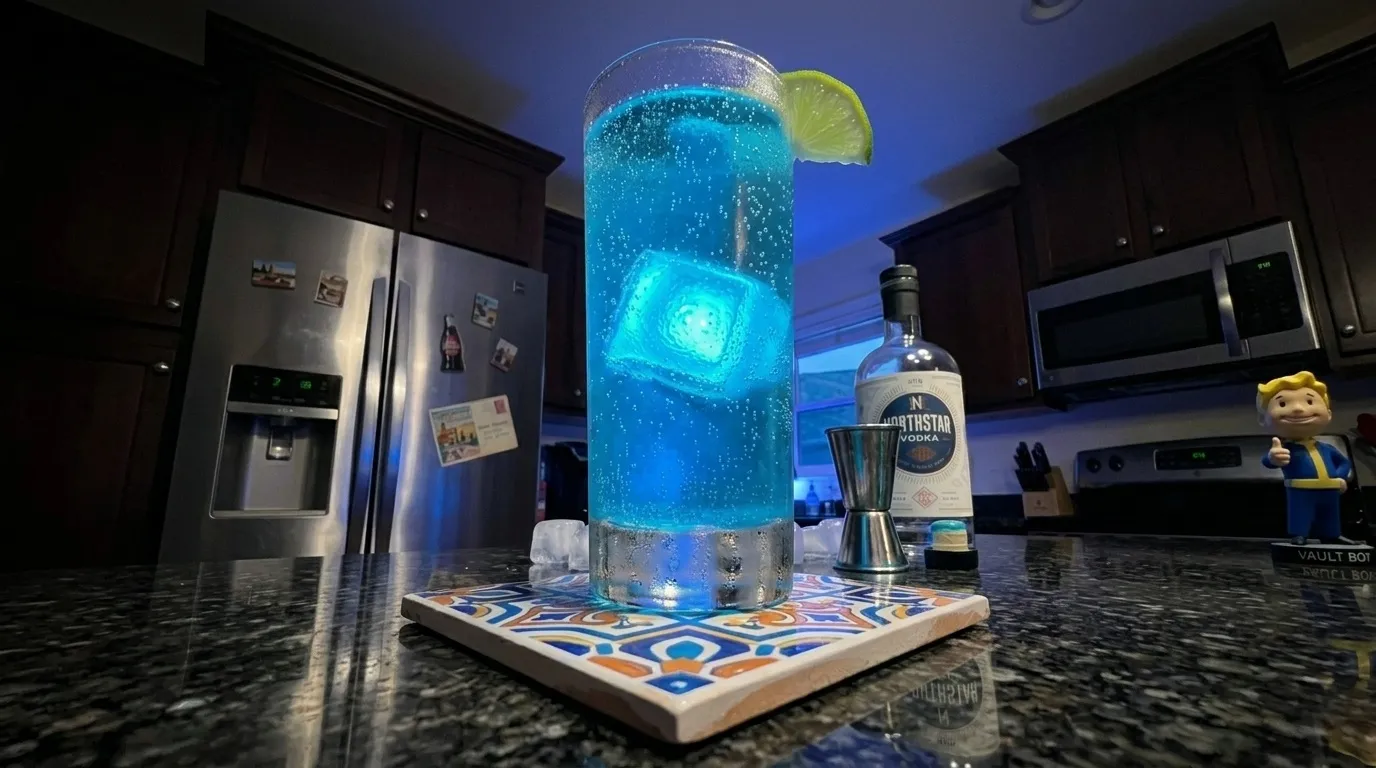
I stood in a parking lot in the Capital Wasteland, next to a shopping cart trading post, in my war-correspondent jacket, holding a two-hundred-year-old irradiated soda, and I thought: this is the best thing I have ever tasted.
“Well?” Javi said.
“I need to buy the whole case,” I said.
Gretchen almost smiled. Almost. “That’ll be four hundred caps.”
Javi drove home with a case of Nuka-Cola Quantum rattling in the truck bed, and I sat in the passenger seat holding one open bottle and taking very small sips because I wanted it to last and also because I was already thinking about how to make it. The Ink Spots were playing again. The landscape was transitioning back from gray-green to green-green. I watched the ruins recede in the side mirror and thought about the woman with the cooler and the ammunition sorted by caliber and the lawn chair with the cushion, and I thought: people are so strange and so wonderful and so absolutely determined to sell each other soft drinks no matter what happens to the world.
I burned through three bottles of the original before I even started recipe testing, which was irresponsible and also non-negotiable. You cannot reverse-engineer something you haven’t studied, and studying, in this case, meant drinking it at different temperatures, at different times of day, with different foods, and once — memorably — at three in the morning while sitting on the kitchen floor because I couldn’t sleep and the blue glow from the bottle was the only light in the room and it felt appropriate.
Here is what I learned from the originals: the blue is not just color. It’s flavor. Whatever isotope situation is creating that glow is also contributing a specific mineral brightness to the taste — something that reads as electric on the tongue, a crispness that goes beyond citrus. This was going to be the hardest thing to replicate.
Attempt one: vodka, blue curaçao, Sprite. This is the recipe you’ll find if you search online, and it is — I’m going to be direct — wrong. Not bad. Not undrinkable. Just wrong. It tastes like a blue drink at a college party. It has no depth, no complexity, no soul. Nuka-Cola Quantum is not a vodka Sprite with food coloring. It is a work of art that happens to be radioactive.
Attempt two: I added fresh lime juice. Better. The acidity woke it up, gave it edges. But still too flat, too one-note. Quantum has this effervescence that feels almost aggressive, and the Sprite was too soft, too polite. I needed a mixer with more bite.
Attempt three: I switched from lemon-lime soda to a combination of soda water and a splash of tonic. The tonic was a revelation — and not just because of the blacklight trick, though I’ll get to that. Tonic water contains quinine, which contributes a subtle, dry bitterness that is absolutely critical to the Quantum profile. That slight bitter edge at the end of each sip? That’s the quinine. In the original, it’s probably the isotopes. In ours, it’s quinine, and the effect is remarkably similar: a drink that doesn’t just taste sweet but has a finish that keeps your mouth interested, that makes you take another sip to re-experience the contrast.
But here’s where it gets genuinely interesting. Quinine fluoresces under ultraviolet light. It absorbs UV radiation and re-emits it as visible blue light. This is not a gimmick — this is actual physics. When you add tonic water to this cocktail and put it under a blacklight, the drink actually glows. Not LED-glow, not party-trick glow. Molecular fluorescence. The same phenomenon that makes Nuka-Cola Quantum glow in the Fallout universe is, in principle, what’s happening in your glass. I realize this is the nerdiest thing I have ever written on this blog, and I write a blog where I pretend I’ve visited Hyrule. But it matters. It matters because the glow isn’t decorative — it’s structural. The quinine that makes it glow is the same quinine that makes it taste right.
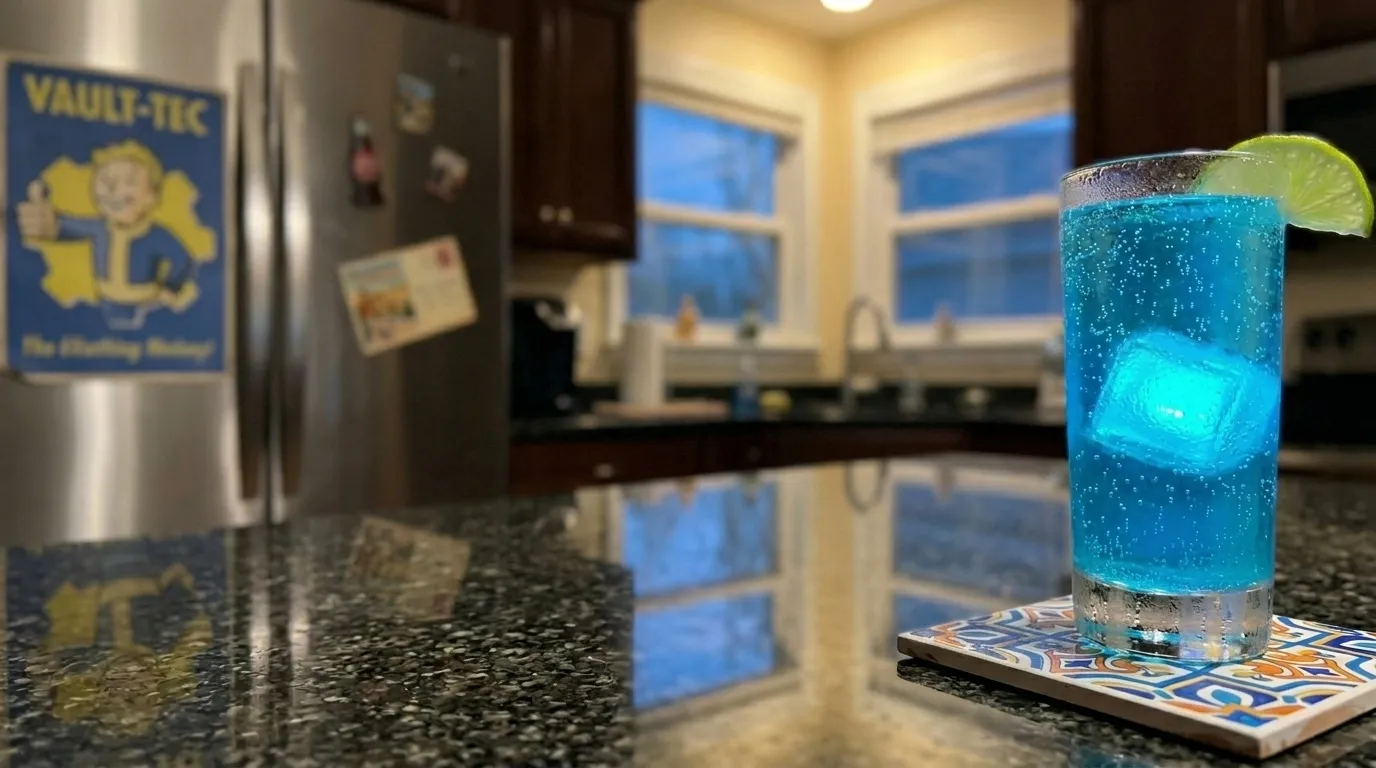
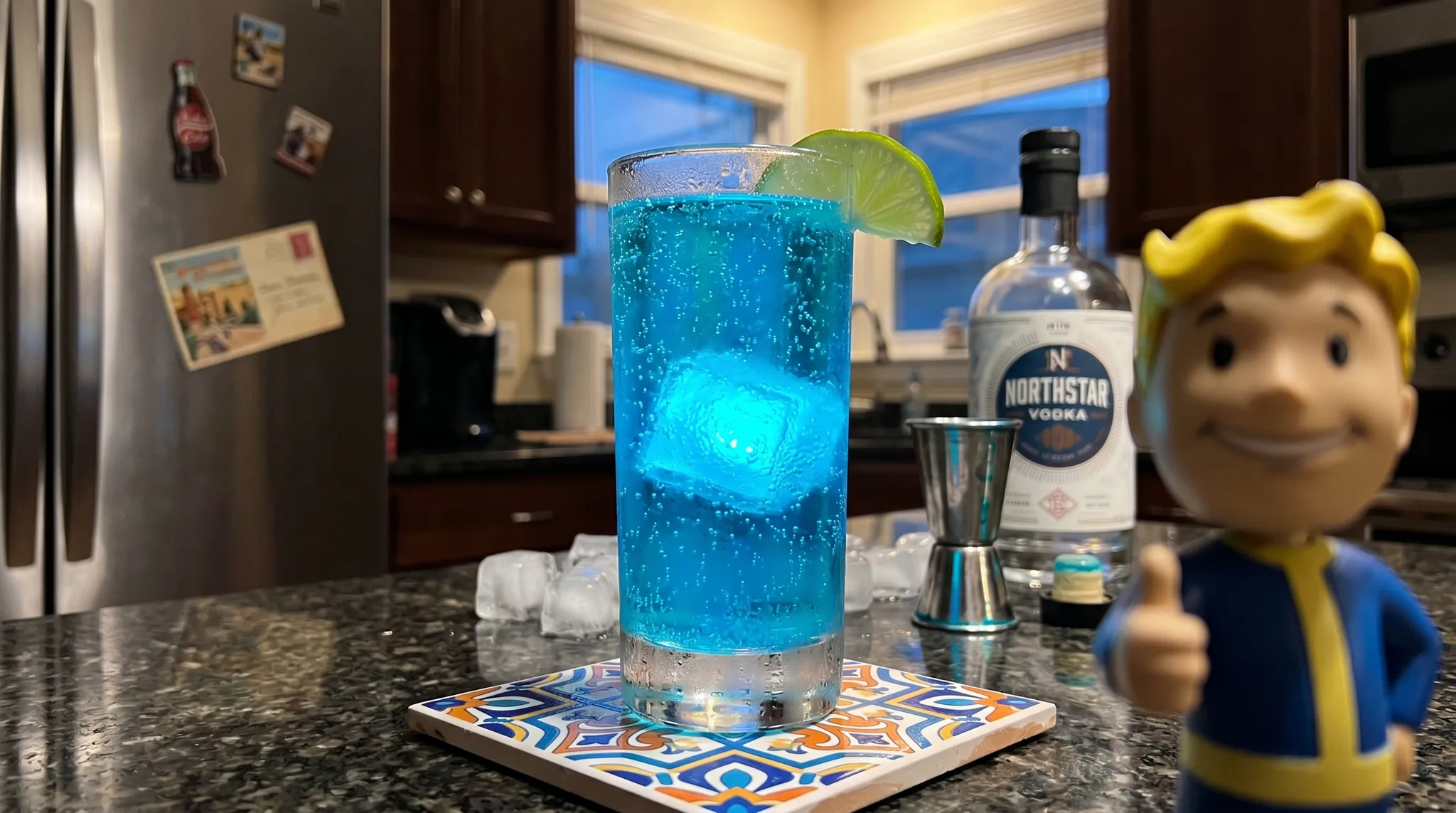
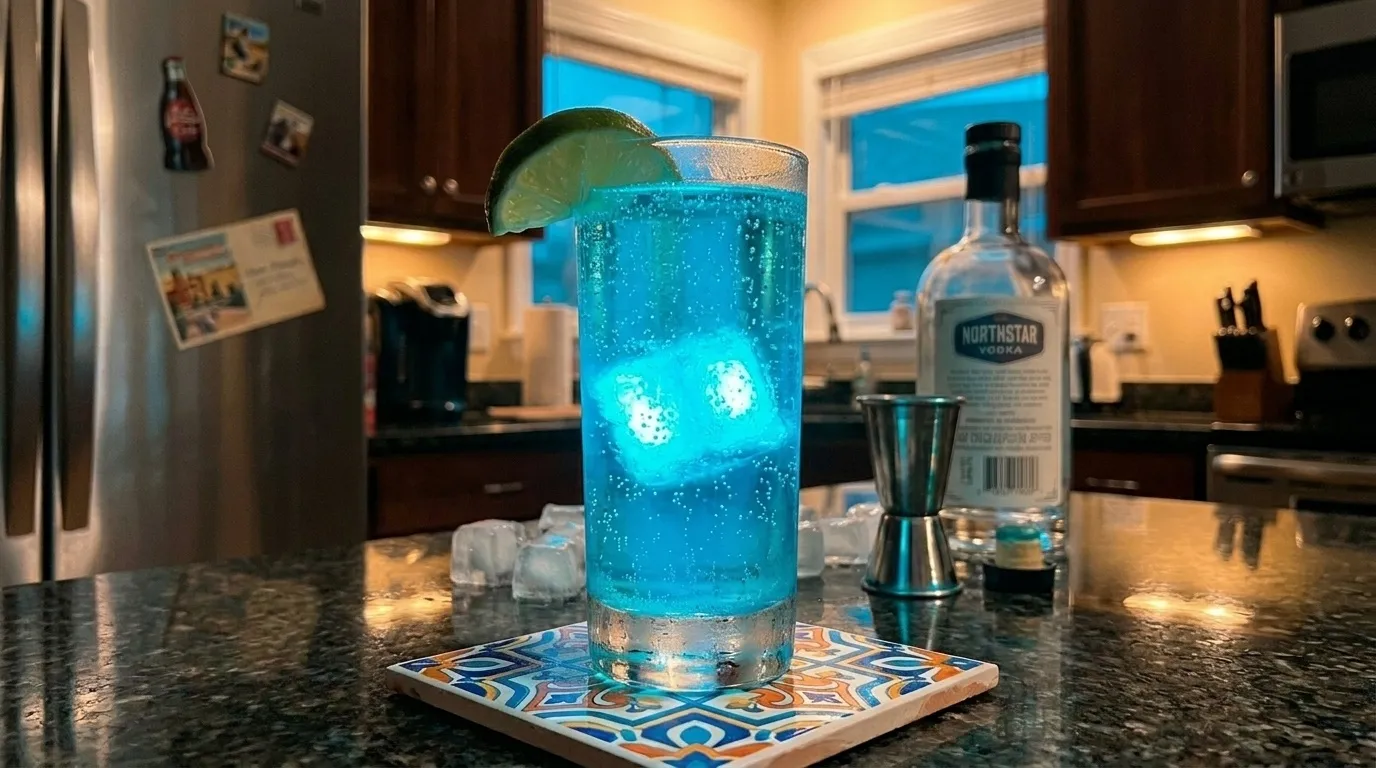
Attempt four was the one. Vodka for clean, neutral spirit — no botanicals competing with the citrus. Blue curaçao for the color and a warm, orange-peel sweetness that fills the middle of the flavor profile. Fresh lime juice for brightness and acidity. Lemon-lime soda for the base carbonation and sweetness. And tonic water — just a splash, an ounce at most — for the quinine bitterness that ties the whole thing together and, yes, makes it glow under the right conditions. The LED ice cube is optional but strongly encouraged, because when you drop it into that blue liquid and watch it light up from within, you will feel something. I don’t know what. Something between nostalgia and joy and the specific satisfaction of having made a thing that glows. That’s the Quantum feeling. That’s what Gretchen was selling for fifty caps in a parking lot, and honestly? She undercharged.
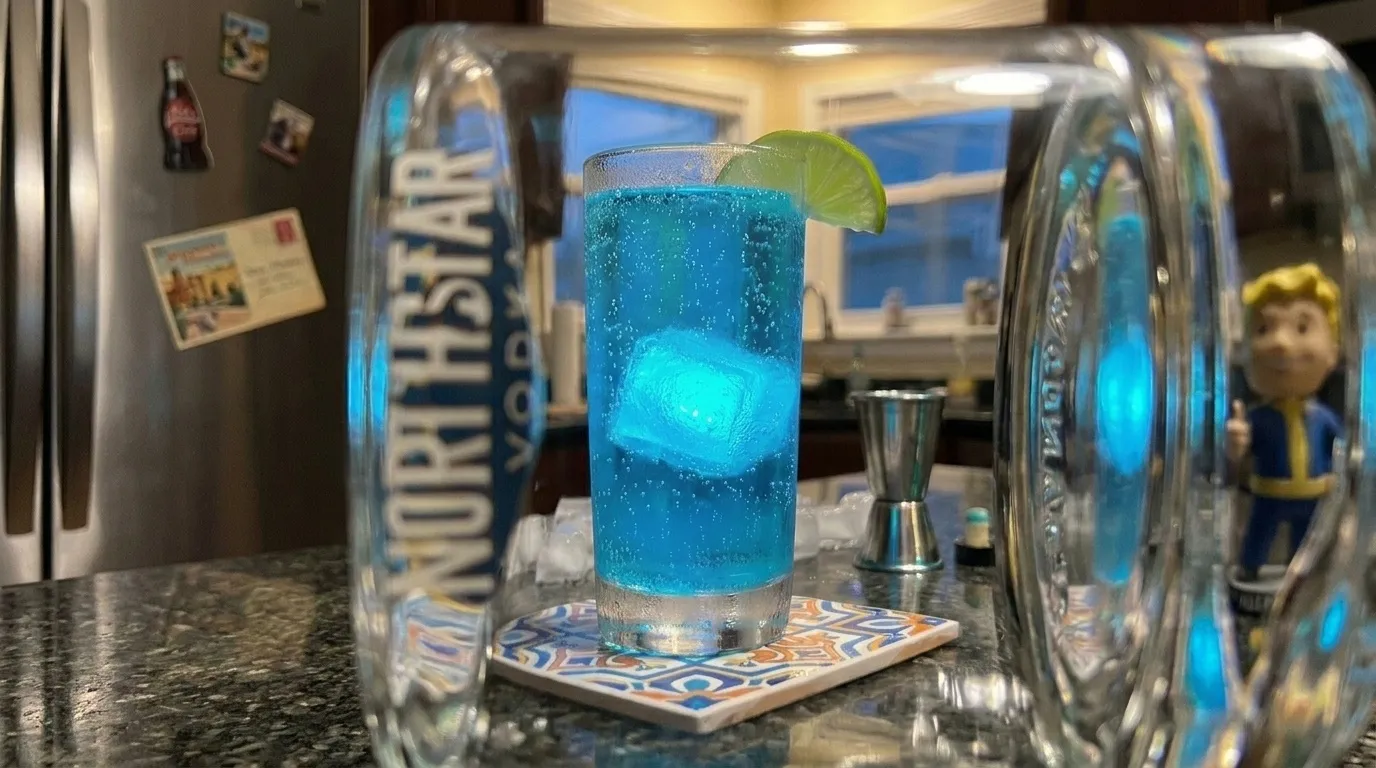
I’ve written it below exactly as I make it. It’s simple — simpler than you’d expect for something this specific — but the proportions matter, the freshness of the lime matters, and the tonic water matters more than you think. Make it in a tall glass so you can see the full column of blue. Make it with ice or with an LED cube or with both. Make it at night, in low light, and watch it glow.
Make this for a wasteland movie night. Make this for someone who needs to believe that even after everything falls apart, someone will still find a way to make something beautiful and fizzy and blue. Make this for yourself on a bad day, because bad days are just the wasteland, and Quantum is what gets you through.
Gretch would approve.
The Wasteland Glow (Nuka-Cola Quantum)
Ingredients
Instructions
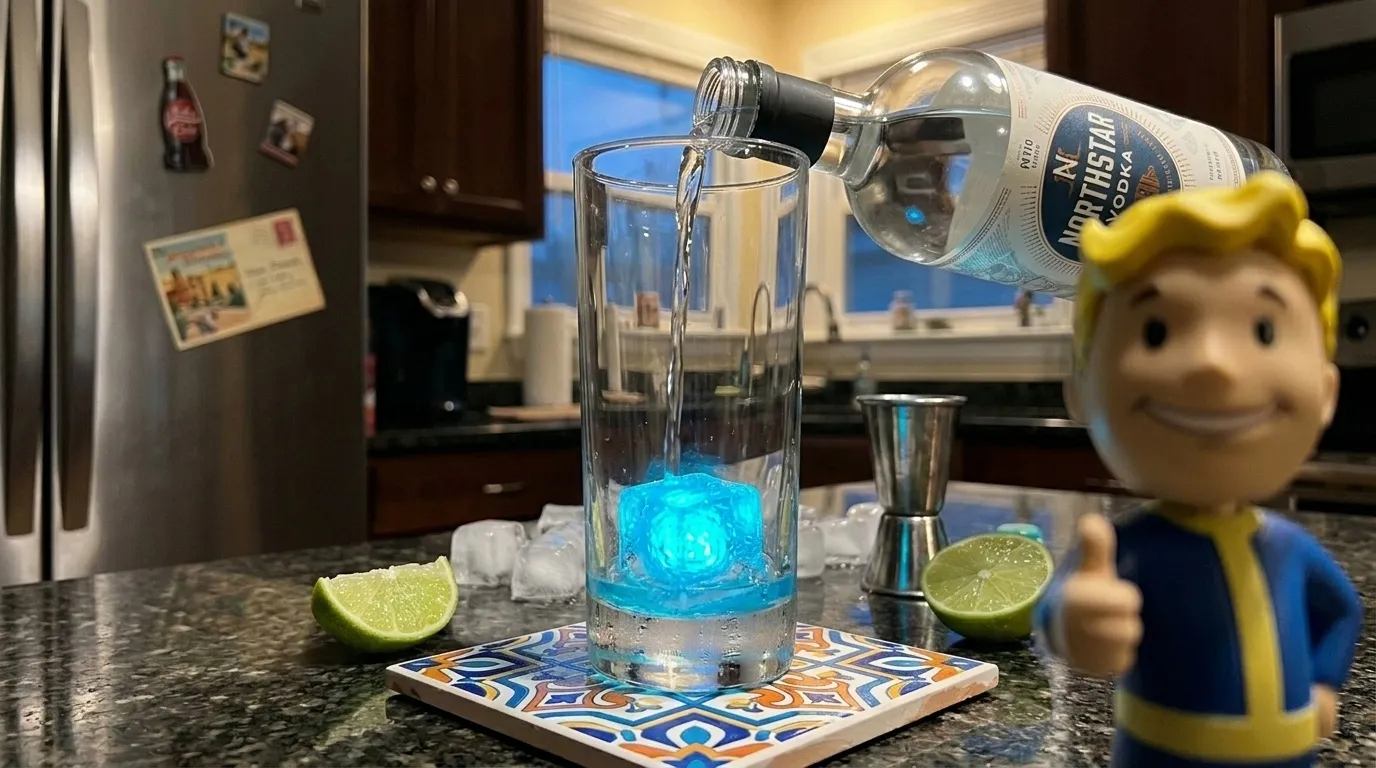
- Drop a blue LED ice cube into a tall glass. Take a moment. Appreciate the commitment to the bit.
- Fill the glass with regular ice on top of the LED cube. You want a full glass — the cold matters and the ice column gives the blue something to glow through.
- Pour the vodka and blue curaçao over the ice. Watch the blue swirl through the clear. This is already beautiful and you haven't even finished yet.
- Squeeze fresh lime juice directly into the glass. Do not use bottled lime juice. Bottled lime juice is what they serve in the vaults and it's why everyone in the vaults is unhappy.
- Top with lemon-lime soda, pouring slowly down the inside of the glass to preserve the carbonation. Aggressive bubbles are the goal. Polite bubbles are for peacetime.
- Add a splash of tonic water and stir gently — you're integrating, not flattening.
- Garnish with a lime wedge on the rim.
- Contemplate the fall of civilization. Sip. Decide it was worth it for this.
Magnolia’s Notes
-
On the vodka: Clean, neutral, unflavored. This is not the drink for your botanical vodka or your cucumber-infused whatever. You want a spirit that disappears into the mix and lets the curaçao and the citrus do the talking. Tito’s, Reyka, or Absolut are all solid choices. If you’re feeling wasteland-authentic, use the cheapest vodka you can find and tell yourself it’s “pre-war surplus.” I won’t judge. (I will slightly judge.)
-
On the tonic water: This is the ingredient people skip and then wonder why their Quantum tastes like a blue vodka soda. The quinine in tonic water contributes a subtle, dry bitterness that is essential to the Quantum flavor profile. Without it, the drink is sweet-citrus-sweet-done. With it, there’s a finish — a slight bitter edge that makes your mouth want another sip. It’s also what makes the drink fluoresce under UV light, which is genuine molecular physics and not a party trick. Well, it’s both. Fever-Tree or Q Tonic are my preference — they have a cleaner quinine profile than the grocery store brands, which tend to overload on corn syrup. You only need an ounce, maybe an ounce and a half. More than that and the bitterness takes over.
-
On the blue curaçao: I know what you’re thinking. I thought it too. Blue curaçao is the drink ingredient that serious cocktail people love to dismiss, and I get it — it’s been abused by every beach bar and freshman mixer in history. But here’s the thing: when used with intention, it’s genuinely wonderful. It’s an orange liqueur with a bitter-orange peel character that fills out the middle of this drink beautifully. The blue is just a bonus. And in this particular cocktail, the blue is the point. Bols or Senior are both excellent. Do not buy the bottle that costs $4.99. You will regret it. You will taste the regret.
-
On the LED ice cube: Optional in a strictly mixological sense. Non-optional in a spiritual sense. You can find them on Amazon or at party stores for a few dollars each, and they are waterproof and reusable and they make this drink look like it contains actual radioactive isotopes. Put one in the bottom of the glass before you add anything else. When the blue curaçao hits it, the whole glass lights up. Serve this at a party in a dark room and people will lose their minds. I served it at a dinner party last month and three people asked me what was in it before they’d even tasted it. That’s the power of the glow.
-
On the blacklight trick: If you own a blacklight — and if you’re making Nuka-Cola Quantum, you probably should — turn off the lights and hold the finished drink under it. The quinine in the tonic water fluoresces, which means it absorbs the UV light and re-emits it as visible blue light. The drink will genuinely, actually, scientifically glow. It’s not bright enough to read by, but it’s bright enough to make you feel like you’re holding something from another world. Which you are. Gretchen would charge extra for this.
Did you make this? Show me your wasteland glow. And if your Pip-Boy starts clicking, you added too much tonic. Probably fine. Drink it anyway.