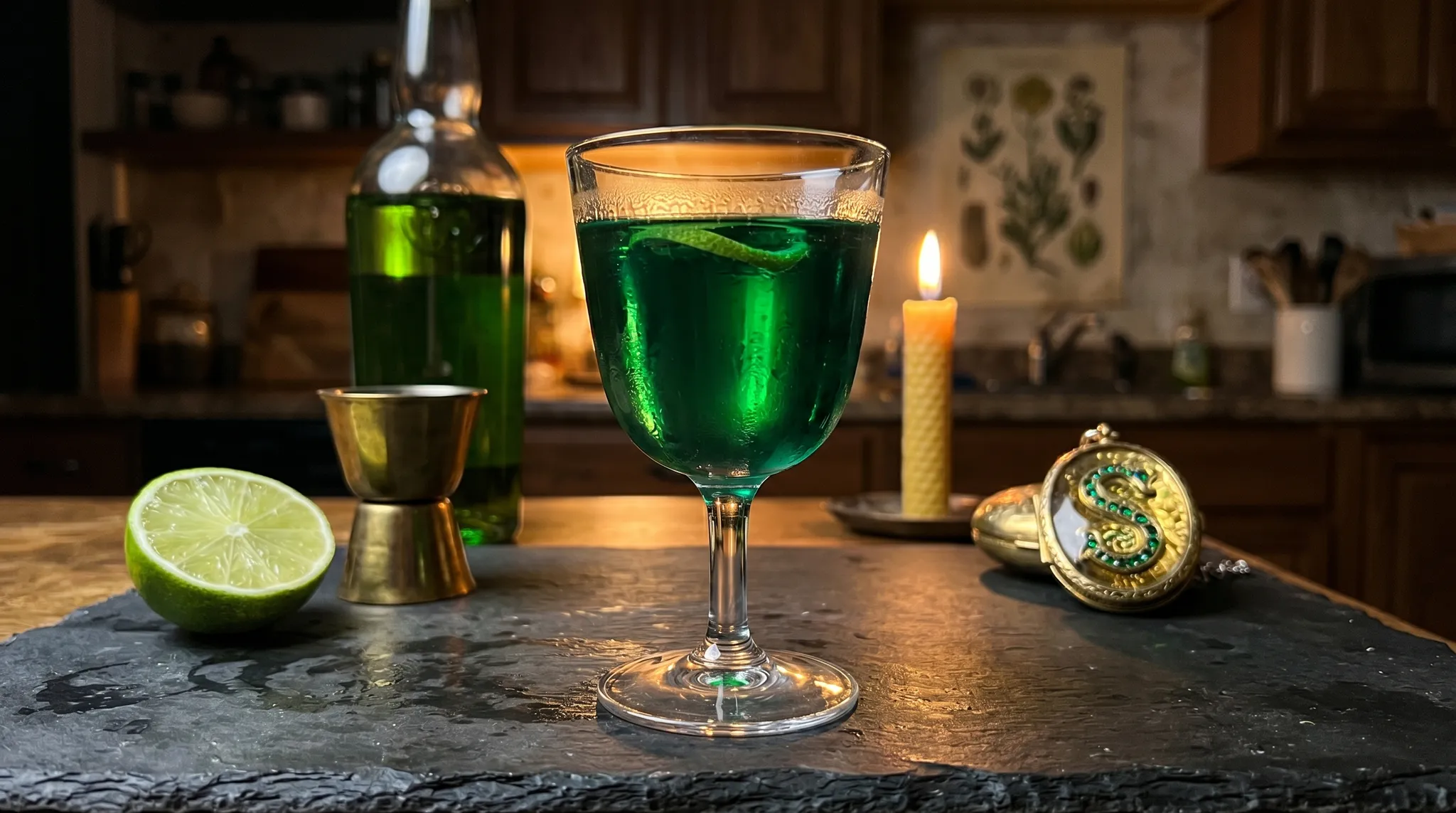
I’m not going to lie. I almost didn’t share this one.
Not because it’s illegal — that was the Romulan Ale problem, and we got through that. Not because it’s difficult, though it is. I almost didn’t share it because some drinks sit in the part of you that doesn’t want to be a food blog. Some drinks want to be quiet. This is the most visually stunning thing I’ve ever put in a glass, and it came from the most devastating thing I’ve ever watched someone drink. I’ve written this post three times now. The first two times I deleted it at 2 AM. This time I’m hitting publish before I can talk myself out of it.
Let me explain. But gently, this time.
The Story
I’ve talked about Hogwarts before — about my mother reading me the books at seven, chapter by chapter, her voice turning the pages into places I could walk through. The Butterbeer post was about the warm side of that. The Three Broomsticks, snow on Hogsmeade, the feeling of being held by a world that wanted to be cozy more than it wanted to be real. That’s the Hogwarts most people carry with them. The Hogwarts of butterscotch and warm mugs and the sound of a fire popping while it snows outside a window you’re safe behind.
But there’s another Hogwarts. The one you reach in the later books, when Rowling stops protecting you. When the hallways get darker and the people you trusted start dying and you realize that the world you fell in love with at seven was always capable of this. I think about that transition sometimes — the exact chapter where it stops being a children’s book. I don’t think you can pinpoint it, but you know when you’ve crossed over. You feel it in your chest.
My friend Jeanette is the person who made me go back to that Hogwarts.
Jeanette is in my book club — the one we started during the pandemic that somehow survived the pandemic, even though we’ve only finished three books in five years and two of those were audiobooks that Priya listened to while driving and then summarized for the group, which several of us have opinions about. Jeanette reads slowly and she reads seriously. She is the only person I know who takes handwritten notes in the margins of novels she owns, in pencil, in handwriting so small you’d need a magnifying glass. She’s the kind of person who underlines passages and then won’t tell you which ones because “you’ll get there when you get there.” She once called me at eleven o’clock on a Tuesday night to tell me she’d cried at Chapter 26 of Half-Blood Prince, even though she’d read it before. Even though she knew what was coming. “Knowing doesn’t help,” she said. “That’s the whole point, isn’t it.”
I didn’t know what to say to that. I still don’t.
“Have you ever been to the cave?” she asked me one morning over coffee. It was a Saturday. We were at that place on Elm with the wobbly table — the one where Jeanette always sits on the left side because the morning light comes through the window there and she likes to read by it. She had a flat white with oat milk. I had a latte that was too hot and I was holding it with both hands anyway because the weather had turned and I was underdressed. Just like that. Casual. Like she was asking if I’d tried the new bakery on Fifth Street.
“What cave?”
“The cave, Magnolia. The Horcrux cave. On the coast.”
I set my mug down. The table wobbled. “No. And I’m not sure I want to.”
She looked at me the way Jeanette looks at people when she’s already decided something and the conversation is just a formality. She has this expression — not aggressive, not pushy, just completely settled. Like she’s already living in the timeline where you said yes and she’s just waiting for the present to catch up. “I’ll book the boat.”
“Jeanette—”
“I’ll book the boat, Magnolia.”
I need to be honest about something. The reason I didn’t want to go wasn’t practical. It wasn’t about the travel or the expense or the time off work. It was because I was scared. Not scared of a cave — I’m a grown woman, I’ve been in caves before, I went to Carlsbad Caverns with Mark’s family and ate a hot dog in the gift shop afterward. I was scared of what I’d feel. There are places you know will demand something emotional of you, and sometimes you’re just not sure you have it to give. I told Mark this while we were doing dishes that night. He handed me a plate and said, “You should go anyway.” Mark is not a complicated man, but he is occasionally an exactly-right one.
The cave is on a stretch of coast that doesn’t appear on most maps, which is the kind of sentence I never thought I’d write on a food blog. You take a portkey to a coastal village — I won’t name it, because the Heritage Preservation Office asked visitors not to, and I respect that — and then you walk about half a mile down a path that’s more suggestion than infrastructure. The grass was wet. My shoes were wrong, again, because I have apparently never learned that “cute ankle boots” and “outdoor terrain” are fundamentally incompatible concepts. Jeanette was wearing hiking boots. Jeanette had packed hiking boots. I had packed mascara and a cardigan.
You get to the cave by boat — a small one, wooden, the kind that makes you aware of exactly how thin the barrier is between you and very cold, very deep water. The pilot was a man named Gethin who speaks mostly in single-word sentences and seems to find tourists mildly exhausting. He had the build of someone who’s been rowing since before you were born and plans to keep rowing after you’re gone. He looked at us, looked at the sky, said “Chop today,” and pushed off from the dock with a single motion that made the boat lurch in a way I did not enjoy.
The coastline is all dark rock and white spray. The cliffs are taller than they look in photographs — sheer and black and streaked with bird droppings and patches of something green and living that clung to the stone like it was angry about being there. The wind hits your face with the specific cold that means the ocean is reminding you it doesn’t care about you. It’s the kind of cold that finds the gap between your scarf and your collar and sets up camp there. I pulled my cardigan tighter. It did not help. It was a decorative cardigan. I was a decorative person in a deeply non-decorative situation.
Jeanette sat at the bow reading a paperback — one of those small hardcovers with no dust jacket, the title stamped directly into the cloth. I never saw what it was. She held it steady in the wind like she’d practiced. I sat in the middle trying not to think about how deep the water was. I thought about it anyway. It was very deep.
“You’re gripping the seat,” Gethin observed. He said it without looking at me, which was somehow worse.
“I’m fine,” I said. I was not fine. The boat rose and dropped with each swell and my stomach rose and dropped with it, about half a beat behind, and I focused on the back of Jeanette’s head and counted her hair clips — three, silver, small — until my breathing settled.
The entrance to the cave is a crack in the cliff face, barely wide enough for the boat to slip through. You scrape rock on both sides going in. The sound echoes — a low, grinding complaint, stone against wood, and then the light changes. Not gradually. Abruptly. One moment you’re in open ocean air and gray daylight and the next you’re inside something that smells like a thousand years of water doing slow work on rock. The air changes immediately: mineral, damp, heavy with the smell of stone that’s been wet for centuries. It smelled like the earth was breathing, and the breath was cold.
There’s a blood payment at the entrance. I won’t make it dramatic — it’s a small cut on the palm, pressed to the rock, and the rock drinks it. That’s the only way to describe it. The blood touches the stone and the stone absorbs it, not quickly, not with any visible effect, but you feel it. Something recognizes you. Something decides to let you pass. The Ministry installed a station with antiseptic wipes and plasters, which is so deeply British in its practicality that I almost laughed — here we are in an ancient cave with blood magic and dark enchantments, and someone from the government has left a first aid box with a little laminated instruction card. Jeanette had brought her own first aid kit because of course she had. She’d also brought tissues, hand warmers, and a granola bar, because Jeanette believes in being prepared for emotional experiences the way other people prepare for natural disasters.
The guide — a young witch from the Heritage Preservation Office named Cressida — was waiting for us inside. She was quiet and precise, the kind of person who speaks in complete sentences and never uses two words where one will do. She had dark hair pulled back and an expression that managed to be both professional and genuinely kind. She watched us with the patient detachment of someone who does this four times a week and still hasn’t gotten used to it.
“Stay on the path,” she said. “Don’t touch the water.”
I was not planning on touching the water.
The passage went on longer than I expected. Cressida walked ahead with a wand-light — steady, pale blue, casting our shadows against walls that glistened with moisture. Nobody spoke. The only sounds were our footsteps, the drip of water from somewhere above, and my own breathing, which sounded unreasonably loud in the enclosed space. Jeanette had closed her book. She was holding it against her chest with one hand. I realized, watching her, that she was nervous too. Jeanette, who had booked the boat, who had packed hiking boots, who had decided all of this — she was nervous. That made me feel better and worse at the same time.
The underground lake is the thing I wasn’t prepared for.
You come around a bend in the passage and suddenly the ceiling opens up and the ground drops away and there’s this vast, black, perfectly still body of water stretching out into darkness. No ripples. No sound. No light except Cressida’s wand, which barely dented the dark. The silence is the kind that makes your ears ring because your brain can’t accept the absence of noise — it fills the gap with a high, thin tone that might be blood pressure or might be the cave itself humming at a frequency you can almost hear. Jeanette stopped walking. I stopped walking. Even Cressida paused, and she’d seen it hundreds of times.
“Every time,” she said softly. Not to us, exactly. Just out loud. A confession to the dark.
We crossed by boat — a different boat, small and spectral, pale as bone, pulled by something beneath the water I chose not to investigate. The lake was black and opaque and perfectly still except where our boat pushed through it, and even those ripples seemed reluctant, spreading slowly and disappearing fast, as if the water preferred to be untouched. I kept my hands in my lap the entire crossing. Jeanette sat very still. She’d closed her book and was holding it in her lap like a talisman. Cressida stood at the front, her wand raised, her face unreadable.
Nobody said anything. There was nothing to say. The cave said it for us.
And then, on the island at the center of the lake, we saw it.
The basin.
It sits on a pedestal of dark stone, ordinary in shape — like a large birdbath, almost, or a baptismal font — extraordinary in what it contains. The emerald potion — the Drink of Despair — is still there. The Heritage Office maintains it as a historical site. They replenish it using the original enchantment. You can’t drink it. Nobody drinks it. But it glows.
I don’t have a better word for it. The green light emanates from the liquid itself, casting the stone basin and the dark water and our faces in this soft, terrible, beautiful light. It lit us from below, which is not a flattering angle for anyone but that wasn’t the point. The point was the color. I need to talk about the color because I have spent months trying to get it right in a glass and the only way to explain what I was aiming for is to describe what I saw.
It’s not neon. Not jewel-toned. Not the green of limes or grass or emeralds, despite the name. It’s deeper than that. Warmer. Alive. The kind of green that has weight to it — green that you could feel on your skin if you stood close enough, and we were standing close enough. It shifted slightly as you watched, like something was moving inside the liquid, not on the surface but deep within, turning and settling and turning again. It was the green of something guarding. Something that had been given a job and would do that job forever.
We stood there for a long time. I don’t know how long. Cressida kept a respectful distance, standing near the boat with her wand lowered, giving us space. She’d done this before. She knew what this moment required.
I thought about Dumbledore. About what it cost him to drink from this basin — not the physical pain, though that was staggering, but the choice. The deliberate decision to swallow something you know will hurt you because the thing on the other side of the pain matters more than you do. He drank and he drank and he drank, and each cup was worse, and he kept going. I thought about Harry, seventeen years old, forced to keep pouring. Forced to keep going when the person he trusted most was begging him to stop.
I thought about my mother, reading me those chapters. How she’d paused when Dumbledore said “Please.” How her voice had gone strange and thin and she’d put the book down for a moment, face-down on her knee, and pressed her fingers against her eyes. I was seven. I asked her why she stopped. She said she had something in her eye. I believed her. I didn’t understand, at seven, why she needed to stop.
I understand now. Standing in that cave, in that green light, I understood.
Jeanette was crying, quietly, the way she does — not dramatically, not performatively, just tears running down her face while she stood perfectly still. The green light caught the tears and made them glow. She didn’t say anything. Neither did I. Some moments don’t need language. They just need you to stand there and let them be heavy.
I knew, standing at that basin, that I was going to make this drink. Not to recreate the potion — that would be grotesque. But to make something that honored what it cost. Something beautiful and deliberately challenging. Something that demands something of you.
On the boat back, Gethin asked if we were all right. I think it’s the longest sentence he’d said all day.
“We’re fine,” Jeanette said. She was not fine. I was not fine. Gethin nodded like he understood.
Getting there took months. I need you to know how many months, because this drink did not come easy and I think that’s appropriate.
The color was the first problem, and it was the hardest problem, and it was the problem that woke me up at 3 AM more times than I want to admit. I had that green burned into my memory — that deep, luminous, almost-alive green from the basin — and everything I tried in my kitchen looked like a costume of it.
Midori was my first attempt. Too candy, too sweet, too cheerful. Midori is the green of a pool noodle. It’s the green of something that wants to be fun at a party. This isn’t a drink that should remind you of a melon or a party or fun. I poured it out and stared at the sink.
Crème de menthe was closer in color but wrong in every other way — toothpaste in a glass. I tried three different brands. The last one, a cheap one from the back of the liquor store that I bought out of desperation, was actually the worst of the three. Mark tasted it and made a face that I think he meant to be supportive but which communicated, very clearly, that he was experiencing regret.
I tried mixing things. Midori and crème de menthe together: somehow worse than either alone. Matcha powder in vodka: cloudy, gritty, tasted like a yoga studio. Spirulina: I don’t want to talk about the spirulina. Let’s just say the color was close but the flavor was an act of aggression against the human palate and Mark refused to be in the kitchen while I was making it.
The breakthrough was Green Chartreuse, and the breakthrough was immediate.
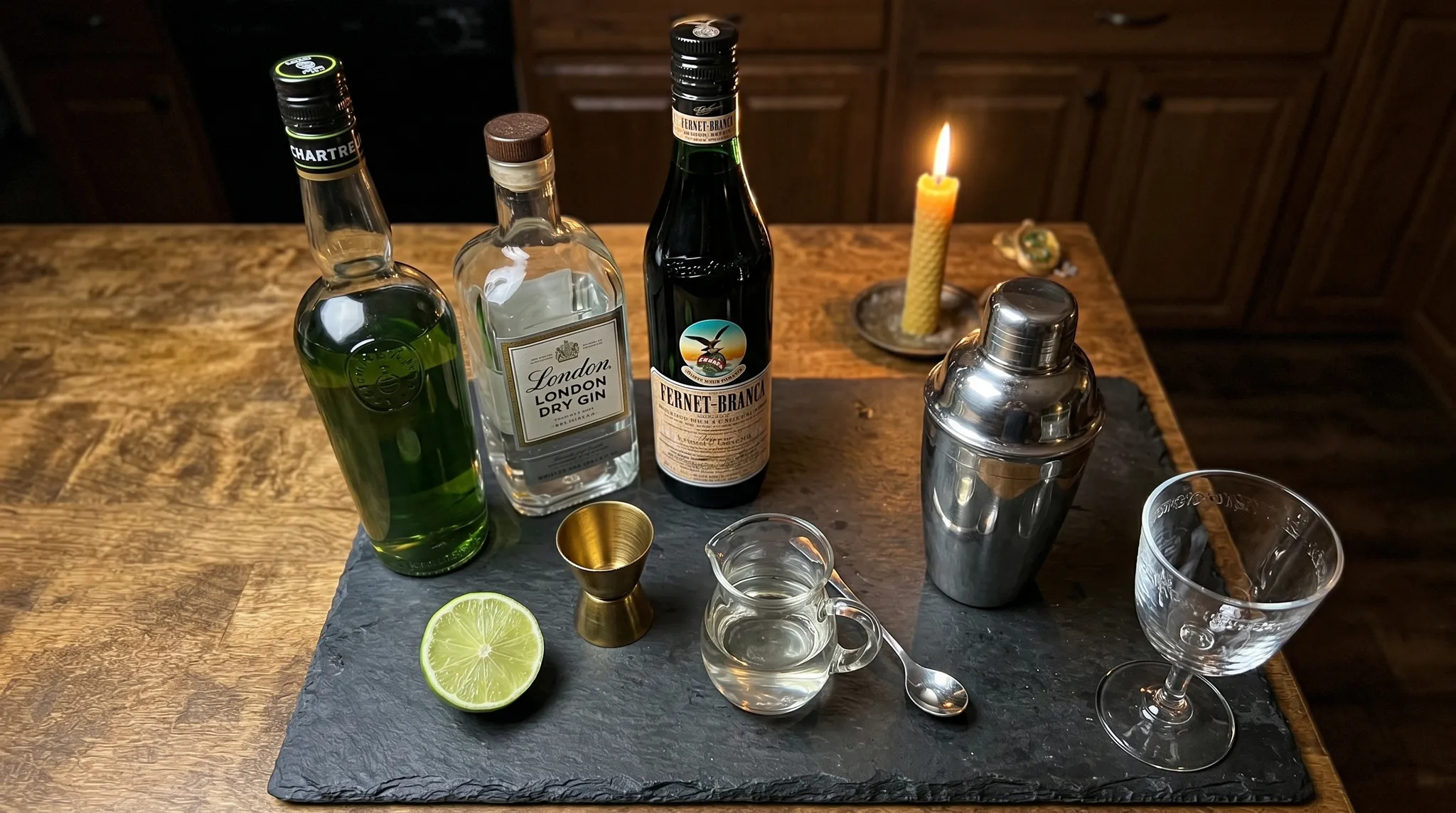
I’d been avoiding it because of the price — Chartreuse is expensive, genuinely expensive, in the “I need to justify this to myself at the checkout counter” range. But a friend from my cocktail meetup group had been evangelizing about it for months, and I finally caved and bought a bottle. One hundred and thirty botanicals. A recipe guarded by Carthusian monks since 1737, known in its entirety to exactly two monks at any given time, and they are not allowed to travel together in case of accident. Think about that. A recipe so precious that the people who make it have built their entire lives around the possibility of losing it. A secret protected for nearly three hundred years by people who have taken vows of silence.
The moment I poured it, I understood. This was the right spirit for a drink that guards a Horcrux.
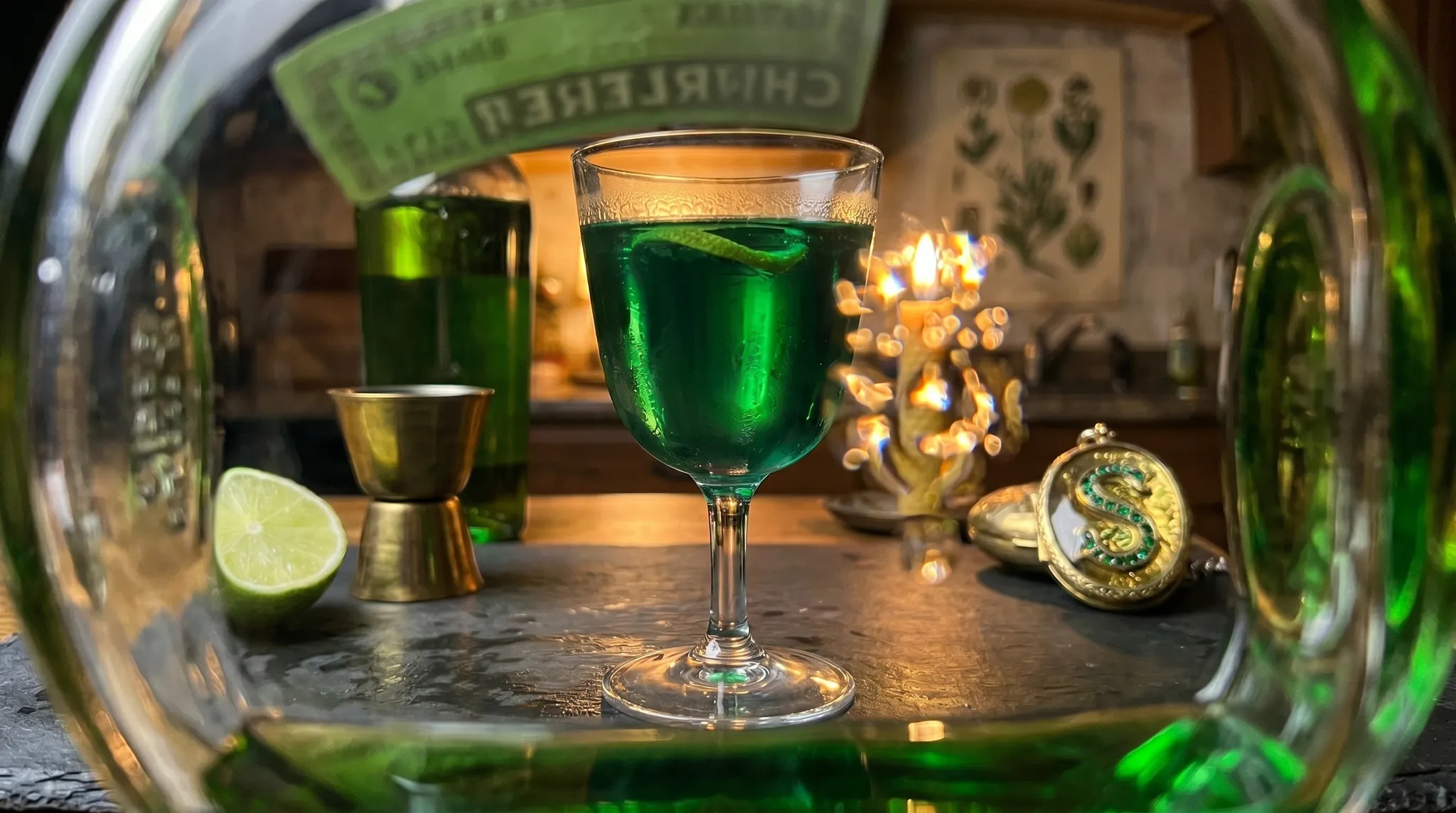
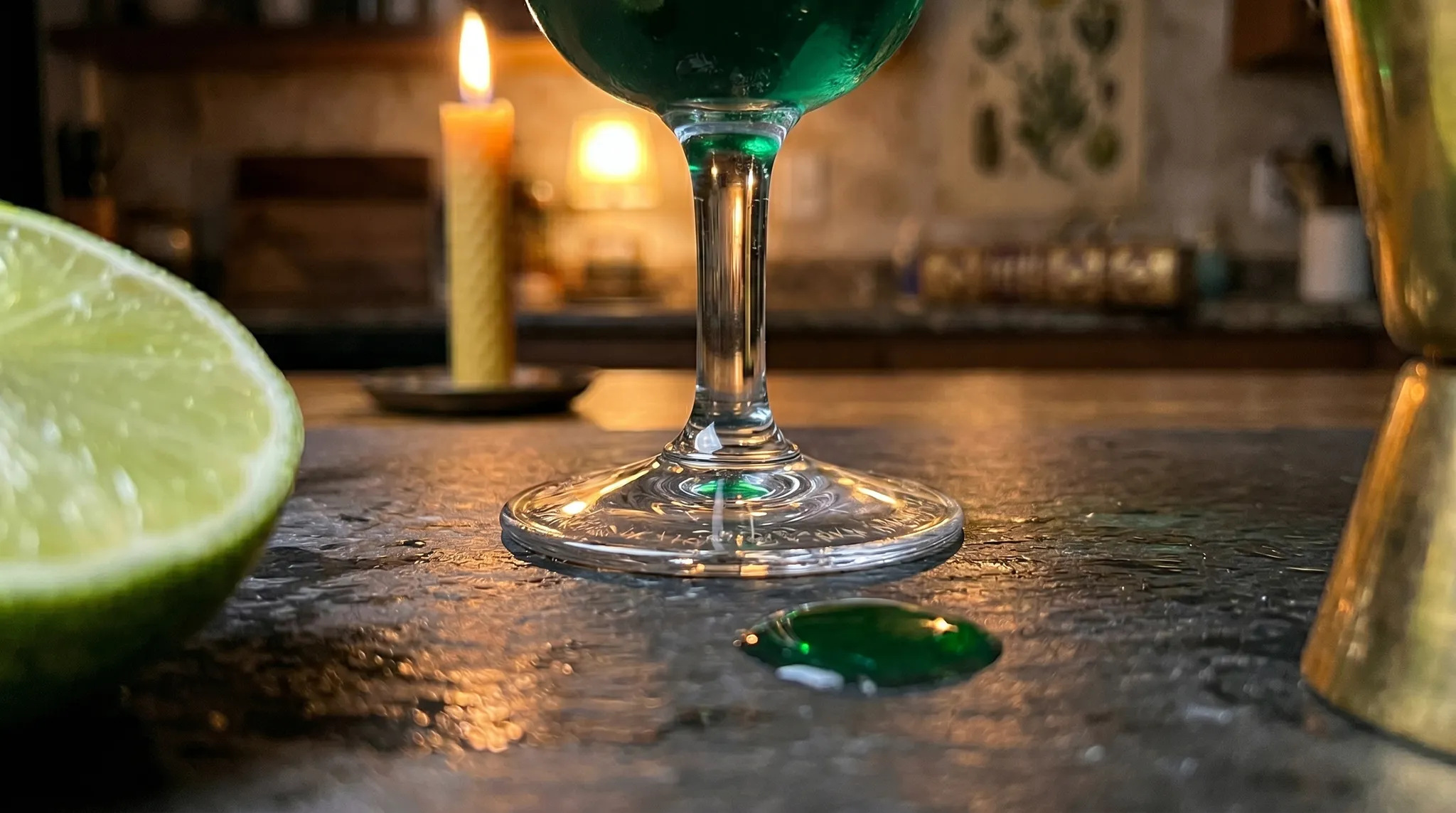
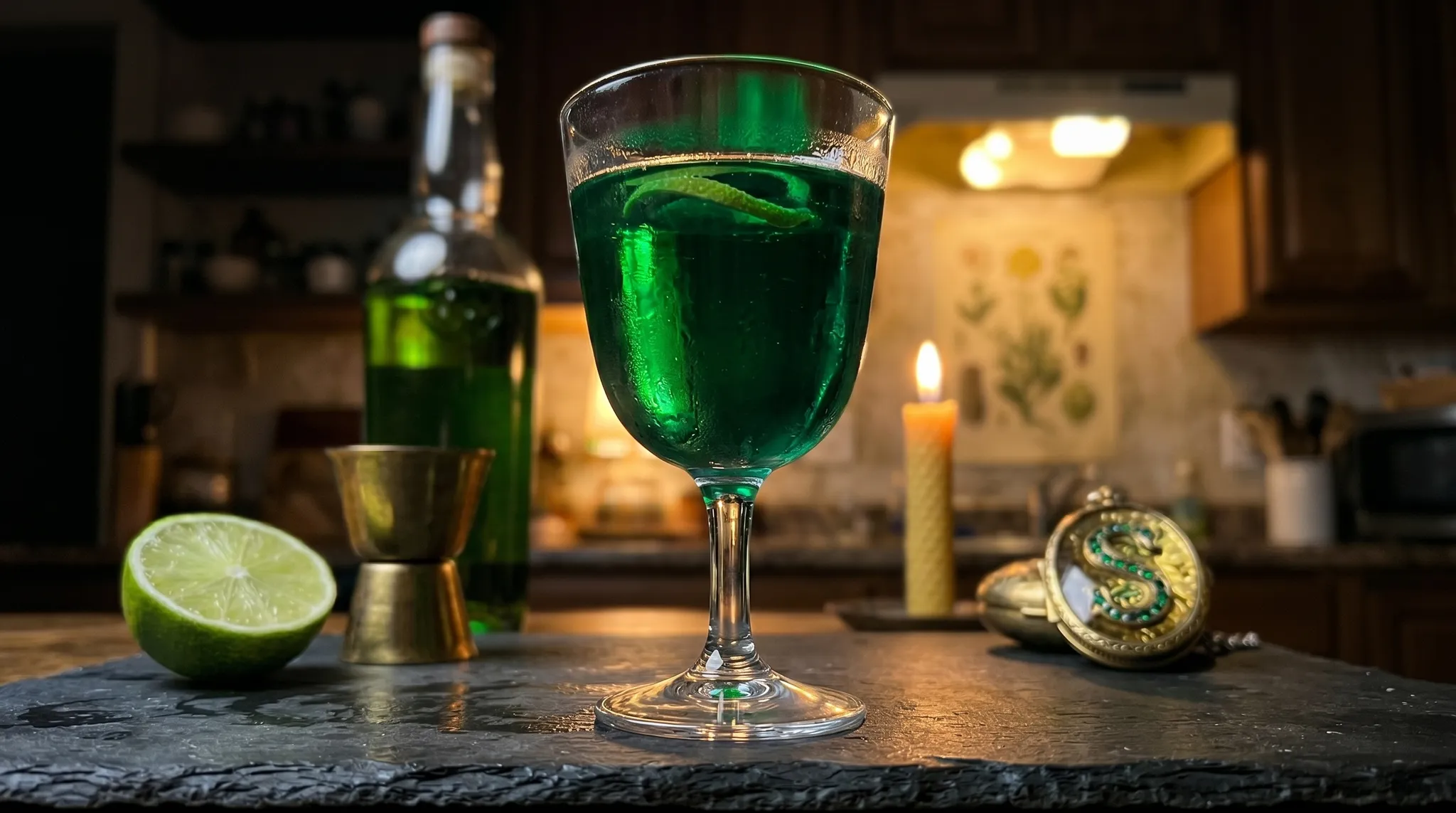
The color was deep and herbal and alive — not the flat green of food coloring or the neon green of novelty spirits, but a green with layers to it, a green that changed as the light shifted, that looked one shade in the glass and another shade when you held it up to the light and another shade still when it caught the warm glow of my kitchen lamp. Complex, botanical, almost sentient in how it changes on your palate — the first sip gives you honey and anise, the second gives you mint and something you can’t name, the third gives you the feeling that you’re tasting something old. Not stale. Old. There’s a difference. Not easy. Not trying to be liked. Exactly like the potion in the basin.
The Fernet-Branca was the second revelation, and it came from a failure. Batch five was beautiful. It was the right color, the right temperature, the right viscosity. It was also, I realized, taking a sip in my kitchen at eleven o’clock at night, too pleasant. It went down smooth and easy and it tasted like a very nice green cocktail and it had no teeth. The Drink of Despair should have teeth. It should make you pause. It should make you decide.
I needed bitterness — not cocktail-bitter, not the polite bitterness of Angostura in an Old Fashioned, but cost-bitter. The kind of bitter that makes you pause mid-sip and decide whether you’re going to keep going. Fernet-Branca does that. It’s aggressive and mentholated and deeply polarizing — people who love it love it, and people who don’t look at you like you’ve suggested they drink furniture polish. At half an ounce, it doesn’t dominate. It lurks. It sits underneath the Chartreuse and the gin and the lime like a question you weren’t expecting, and when it arrives on the back of your tongue, you feel it. You feel it the way you feel a chapter turning. It is exactly the ingredient that separates “pretty green cocktail” from something that earns its name.
The absinthe rinse was the final piece, and it came to me not through experimentation but through standing in my kitchen on a Wednesday afternoon, staring at the bottle of St. George on my shelf and remembering Cressida saying “Stay on the path.” The rinse doesn’t add absinthe to the drink — it prepares the glass. You swirl it inside the goblet and pour it out, and what remains is a ghost. A scent. A thin, anise-laced warning that hits your nose before the liquid ever touches your lips. It’s like warding. Like the enchantment on the cave entrance. Like a last chance to turn around before you commit.
I should tell you about the gin, because the gin is doing more work than you think. London dry, not Plymouth, not navy-strength — for this drink, you want the gin to be architecture, not personality. Beefeater works. Tanqueray works. Ford’s is lovely if you can get it. The juniper provides structure for the Chartreuse to lean against, and the clean citrus notes give the lime juice something to harmonize with. At one ounce, it’s an equal partner with the Chartreuse, not a dominant one. I tested it at an ounce and a half and the drink lost its mystery. The gin got too loud. The whole point is that no single ingredient is in charge — they’re all in service of something larger than themselves.
This drink is not for everyone, and that’s by design. Don’t make it for a party. Don’t make it to impress someone. Make it on a night when you want to sit with something heavy and beautiful and a little bit painful. Make it for someone who understands Chapter 26. Make it for the person who cried at eleven o’clock on a Tuesday.
Dumbledore drank so we could remember. The least we can do is raise a glass.
The Cave's Burden (Drink of Despair)
Ingredients
Instructions
- Rinse a chilled crystal goblet with absinthe — swirl it, coat the inside, discard the excess. The glass should smell like a warning.
- Combine gin, Chartreuse, Fernet-Branca, lime juice, and simple syrup in a cocktail shaker.
- Add ice and shake hard for 12-15 seconds. You want this cave cold.
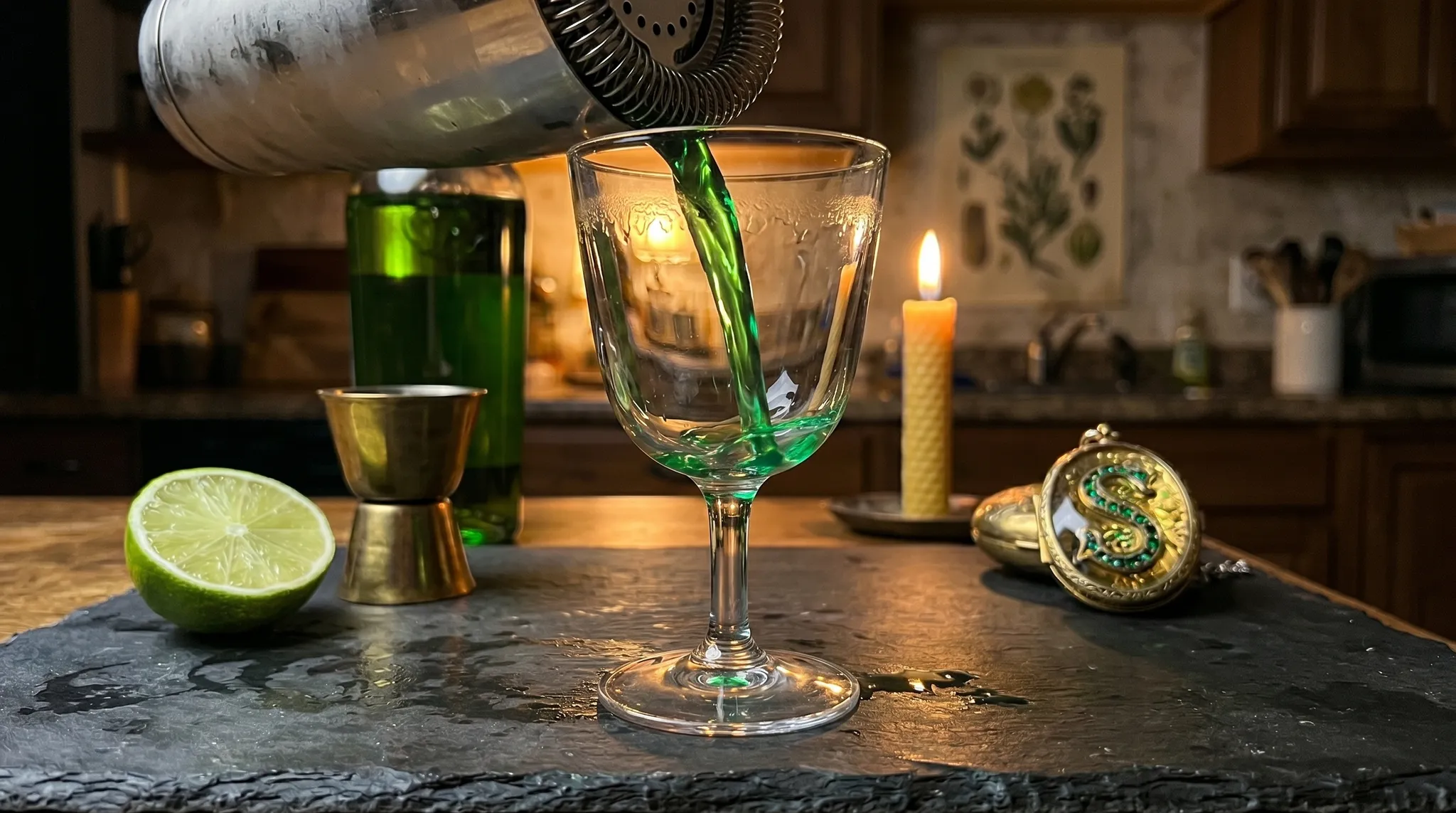
- Strain into the absinthe-rinsed goblet. Watch the color settle.
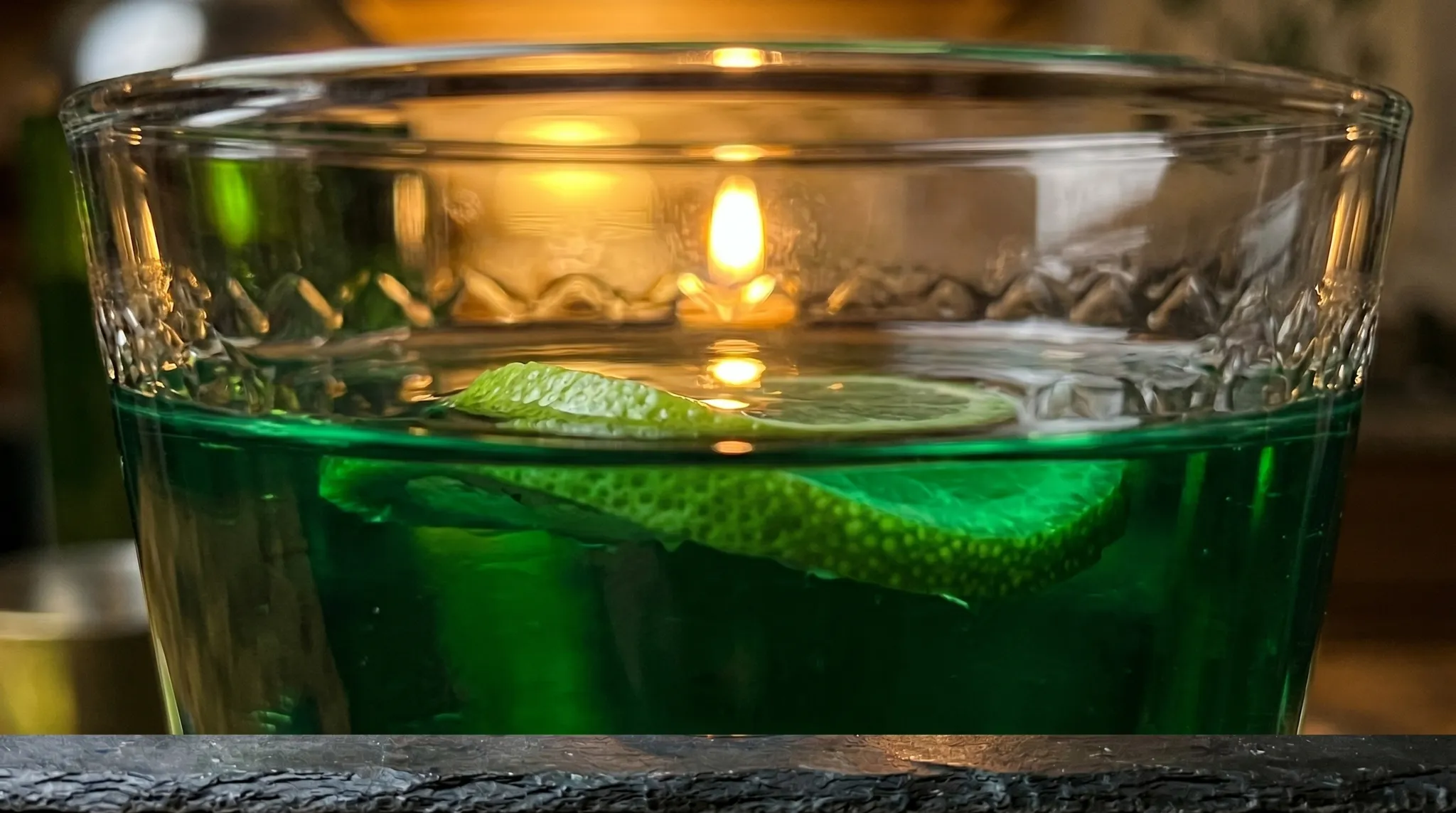
- Express a lime peel crescent over the surface and let it float. It should sit there like it's guarding something.
- Drink slowly — Dumbledore didn't rush.
Magnolia’s Notes
- On the Chartreuse: Non-negotiable. It’s made by two monks who are the only people alive who know the full recipe. It’s expensive — somewhere in the $60-70 range for a 750ml bottle, depending on where you live and whether your state has opinions about liquor distribution. It’s worth every cent. The depth, the complexity, the way it changes from the first sip to the last — nothing else does what Chartreuse does. If your liquor store doesn’t carry it, find a better liquor store. If your liquor store carries it but only the yellow, that’s a different product and a different drink. You want the green. Accept no substitutes.
- On the Fernet: This is the ingredient that separates “green cocktail” from Drink of Despair. Fernet-Branca specifically — not Fernet Vallet, not Branca Menta, not any of the other fernets that exist in the world. Branca has a mentholated intensity that the others don’t match. You can reduce to a quarter ounce if you must, but know that you’re softening the experience. The whole point is that it asks something of you. If you taste it and flinch, that’s correct. Keep going.
- On the absinthe rinse: You’re not adding absinthe to the drink — you’re preparing the glass. Pour about a quarter ounce in, swirl it around the inside of the goblet, and dump the excess. What stays behind is a ghost — a thin, herbal, anise scent that greets you before the liquid does. St. George Absinthe Verte is my first choice. Pernod works if that’s what you have. The rinse should make you pause when you bring the glass to your nose. That pause is the point.
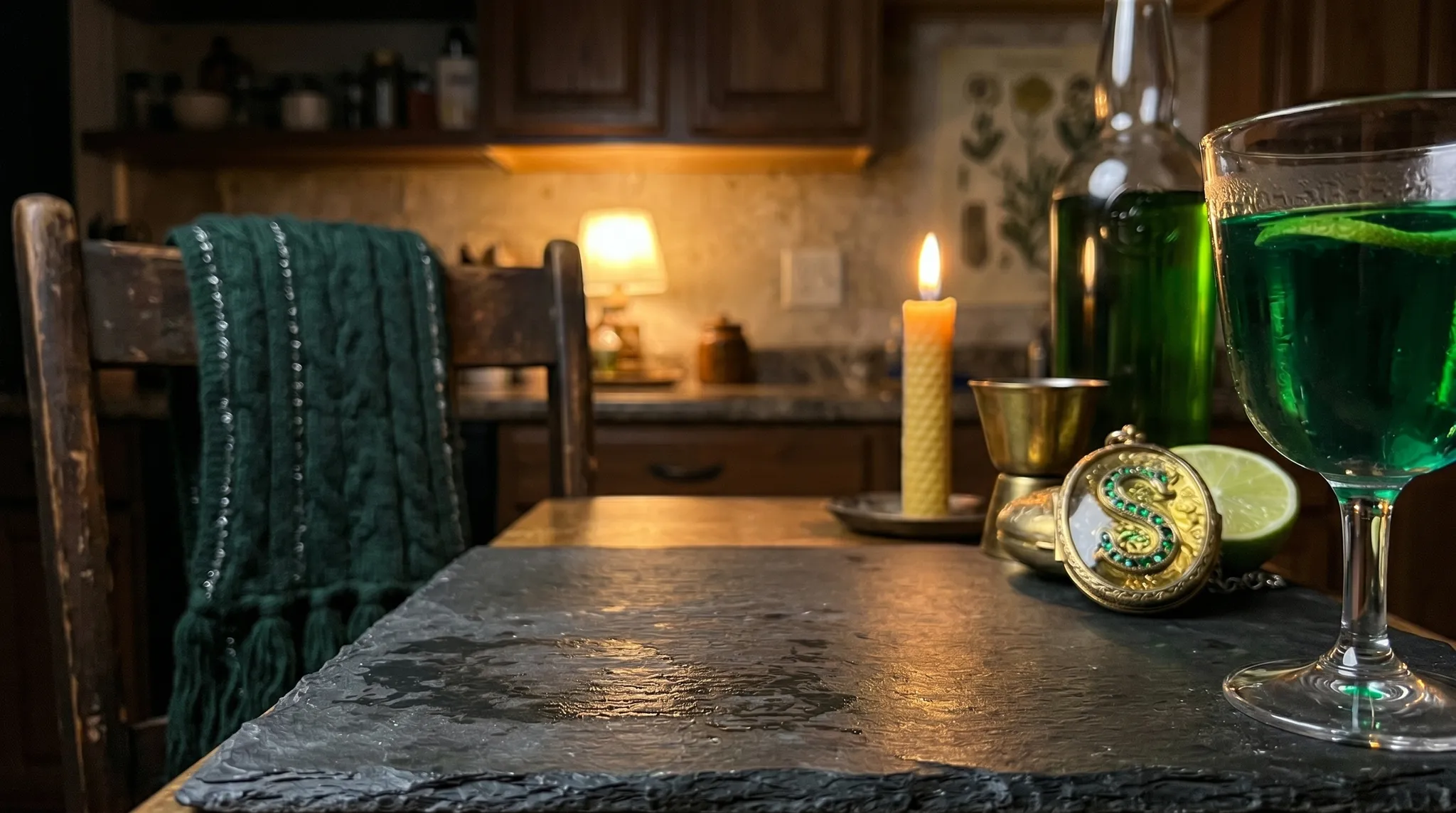
- On the color: If it doesn’t look like it could guard a Horcrux, add a touch more Chartreuse. You want deep and luminous, not pale and apologetic. Hold it up to the light — it should glow from within, not just sit there being green. The Fernet will darken it slightly, which is good. You’re not making a mojito. You’re making something that has seen things.
- On the glassware: Crystal goblet or coupe. Not a rocks glass. Not a martini glass. This drink earned its drama and it deserves a vessel that takes it seriously. I found my goblet at an antique store for four dollars and it is the best four dollars I have ever spent.
Did you make this? I want to see it. But don’t tell me it was easy — I won’t believe you.