I’m not going to lie. I have cried exactly four times because of a beverage, and three of those times were in the same week, in my kitchen, at hours that no reasonable person should be operating a saucepan.
But we’ll get to that.
First I need to tell you about my mother, and the books, and the winter my sister Lena and I finally went to Hogsmeade, and the mug of Butterbeer that ruined me for every other warm drink I have ever tasted or will ever taste for the rest of my entire life. Including hot chocolate. Especially including hot chocolate.
My mother read me the Harry Potter books when I was seven years old. Every night before bed, cross-legged on the quilt my grandmother made from old church dresses, her voice carrying me through Hogwarts corridors and Quidditch matches and the very specific trauma of being an orphaned child wizard destined to defeat the literal embodiment of evil. She did all the voices. Hagrid was her best one. She made him sound like a large, kind furnace. Snape sounded like her divorce attorney, which in retrospect was probably intentional.
But the thing that stayed with me — more than the magic, more than the wand movements, more than the implicit lesson that love conquers dark lords and also bureaucratic incompetence — was the Butterbeer. Rowling described it the way Ree Drummond describes a cast-iron skillet: with a reverence that made you feel like you were failing at life for not already owning one. Warm. Butterscotchy. Slightly foamy on top. Served in the Three Broomsticks while snow fell on Hogsmeade and the whole world felt like a hug from someone who actually means it.
I spent twenty years carrying that taste in my head. Not the real taste — the imagined taste, which is always better and always worse, because it can never be exactly right. Mark says I do this with everything. He says I build things up in my mind until the real version can’t compete. He said this to me once about a resort in Turks and Caicos and I did not speak to him for forty-five minutes.
I need to be honest — I was scared to try to make this one. Some things are too important to risk getting wrong.
And then Lena called.
My sister Lena is three years younger than me and approximately three hundred percent more decisive. She does not deliberate. She does not weigh pros and cons. She sees a thing and she walks toward it at a pace that suggests she’s late for something, even when she isn’t. Last April she called me on a Tuesday — I was unloading the dishwasher, which I mention only because I dropped a mug when she said what she said and it was one of my good mugs, the blue one from that ceramics place in Asheville — and said, in the tone of someone confirming a dentist appointment: “I booked us tickets to Hogsmeade. We leave Thursday.”
“Thursday this Thursday?”
“Do you know another Thursday?”
I did not know another Thursday.
“Lena, I have — I’m supposed to be testing a new butterscotch base recipe this week. I just bought the brown sugar. I bought the good brown sugar.”
“Bring it,” she said, and hung up.
Here is what I packed, because it matters: two sweaters (one cable-knit, one that Mark calls my “Weasley sweater” because it’s maroon and slightly too large), the brown sugar (sealed in a Ziploc inside another Ziploc because I’m not an animal), my notebook with six pages of Butterbeer research, a pair of boots I’d bought specifically for cobblestone streets, and the absolute wrong jacket. I packed the wrong jacket. I knew it was wrong when I packed it and I packed it anyway because it’s the jacket I feel brave in, and sometimes you need to feel brave more than you need to feel warm.
It was nineteen degrees in Hogsmeade. I learned this approximately four seconds after stepping off the carriage.
Lena was wearing a puffer coat rated to negative thirty. She looked at me and my insufficient jacket and said nothing, which was worse than saying something.
Hogsmeade in winter is — okay. I need a moment with this. I need you to understand what it’s like to walk into a place you’ve been imagining since you were seven years old and discover that your imagination was conservative. The snow wasn’t falling so much as arriving. Fat, intentional flakes that landed on your shoulders and stayed there like they’d chosen you specifically. The cobblestones were uneven and wet and my boots — the cobblestone boots — turned out to have absolutely no traction, so I spent the first fifteen minutes walking like a baby deer while Lena strode ahead in her sensible hiking shoes, not looking back.
The village was smaller than I expected. Tighter. The buildings leaned into each other like old friends sharing a secret, their peaked roofs heavy with snow. I could smell wood smoke and something sweet — toffee, maybe, or caramel — drifting from a shop I couldn’t see yet. A group of Hogwarts students in Hufflepuff scarves were clustered around a bench, laughing about something. One of them had spilled hot chocolate on his robes and didn’t seem to care.
I cared. I cared about all of it. I was cataloguing everything — the color of the lanterns (warm amber, not yellow, there’s a difference), the sound of our boots on the stone (mine: uncertain clicks; Lena’s: purposeful thuds), the way the frost had crept up the shop windows and stopped at exactly the point where the interior warmth said no further. Mark texted me: “Having fun?” I wrote back: “I can’t feel my arms.” He sent a thumbs-up emoji.
The Three Broomsticks sits at the end of the high street like a period at the end of a sentence. You can’t miss it and you’re not supposed to. The door was heavy oak with iron hardware, and when Lena pushed it open, the warmth hit us like a wall. Not a gentle transition. A wall of warmth, flavored with woodsmoke and cinnamon and something yeasty and alive. The noise inside was enormous — every table full, voices layered over each other in that specific way that means everyone is having a better time than they expected.
I need to tell you about the bar. The bar was made of a dark wood — walnut, I think, or maybe oak that had simply absorbed two hundred years of spilled mead and good intentions. It was scarred and nicked and someone had carved initials into the far corner. The surface was slightly sticky in the way that all great bar surfaces are slightly sticky. There was a brass rail at the bottom that was polished to a mirror finish from decades of people resting their boots on it, and I looked at it for probably too long, thinking about all the feet that had been there before mine.
Madam Rosmerta was behind the bar. She was shorter than I’d imagined — everyone is — but she had this presence, this way of moving through a packed room that created space around her without anyone consciously stepping aside. She was carrying four mugs in each hand, which I still don’t understand, mechanically, and she set them down at a table of what appeared to be off-duty Ministry workers without spilling a single drop.
“Sit anywhere, loves,” she called to us without turning around. “I’ll find you.”
We found a table near the window. The chair was wooden, spindle-backed, and it creaked in a way that was comforting rather than alarming. Lena pulled off her puffer coat with the satisfaction of someone who had packed correctly. I kept my jacket on. I was still not warm.
“Two Butterbeers,” Lena told Rosmerta when she appeared at our table, which was maybe ninety seconds later. Rosmerta moved through that pub like she knew where everyone was going to be before they got there.
“Warm or cold, darlings?”
“Warm,” I said, too quickly, with a desperation that I immediately felt embarrassed about.
Rosmerta smiled. Not a customer-service smile. A knowing smile. The smile of a woman who has watched a thousand people sit in that exact chair and say “warm” in that exact tone. “Coming right up.”
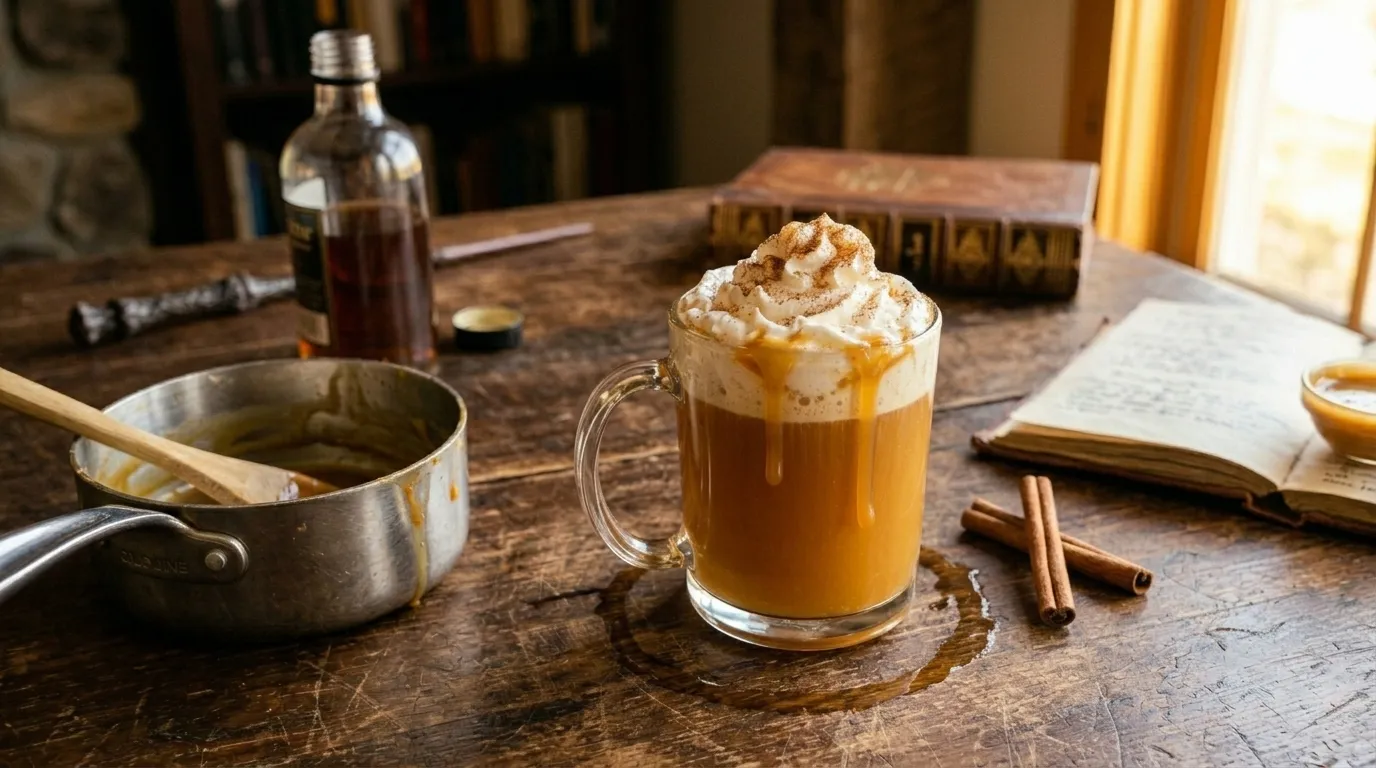
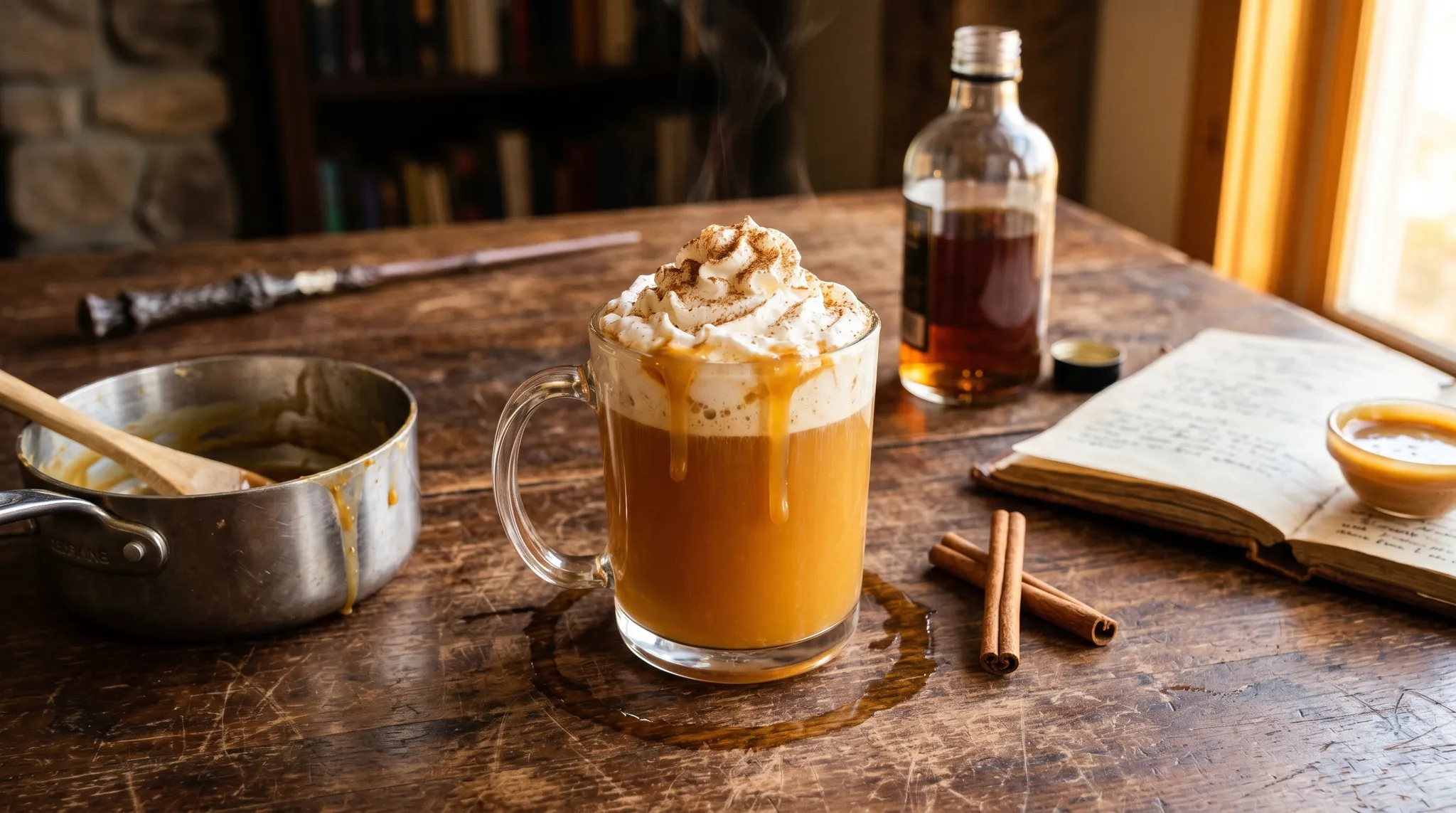
She returned with two mugs. Clear glass, slightly thick, the kind with a handle that’s a little too small for your whole hand so you end up cupping it with both hands anyway, which is somehow part of the experience. And inside —
I need to talk about the color.
The liquid was amber. But not just amber — it was the amber of the specific hour of the day when the sun is lower than you think it should be and everything looks like a memory. Golden, but with a warmth underneath that was almost brown. Almost caramel. It had a luminosity to it, like it was generating its own light from somewhere inside, and the steam rising off the surface caught the firelight from across the room and made these tiny dissolving shapes that I watched for probably ten full seconds before Lena said, “You’re allowed to drink it.”
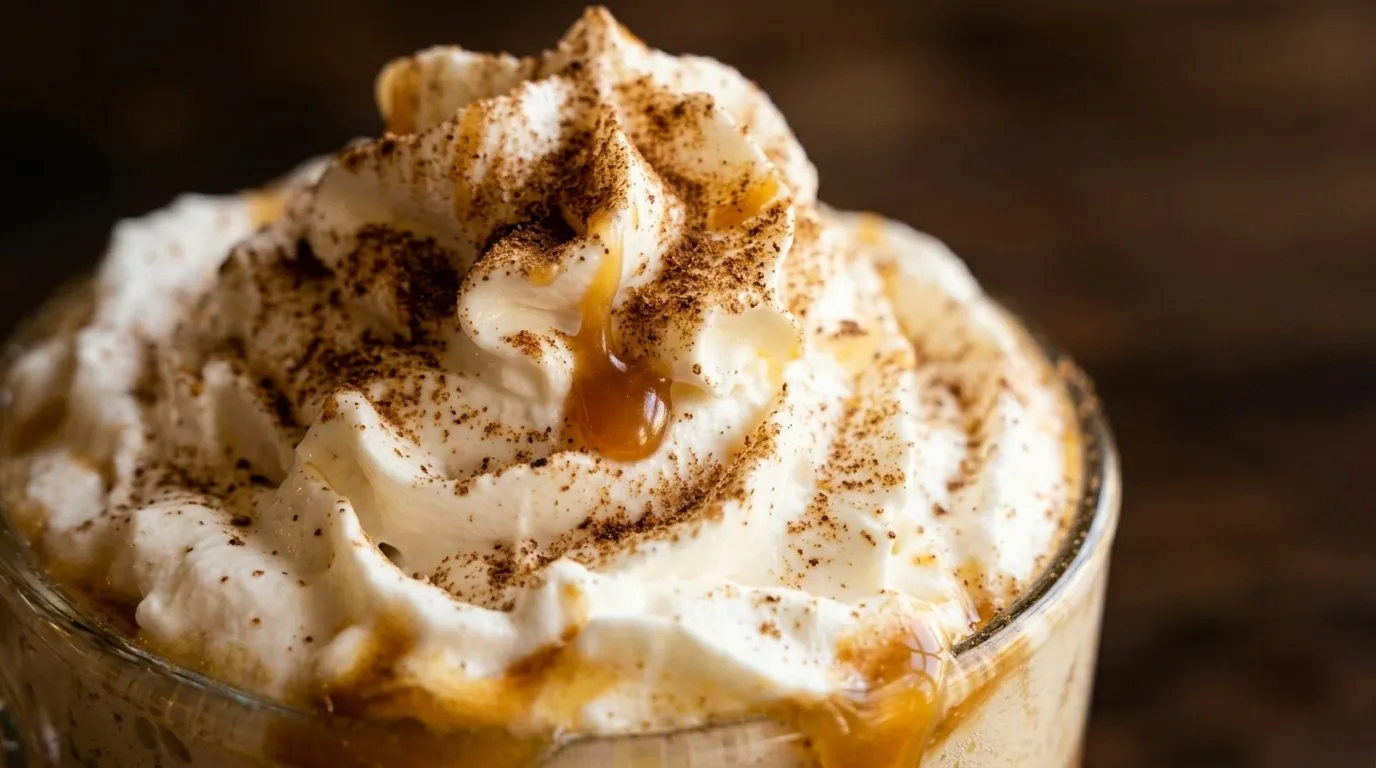
The foam on top was thick and slightly uneven — not piped, not perfect, just placed there, a generous cloud of cream that had been whipped by someone who understood that whipped cream is not decorative frosting, it’s a promise. There were cinnamon flecks on top. Not a dusting. Individual flecks, scattered like they’d been dropped from a height by someone who trusted gravity.
I picked up the mug. It was almost too warm. Almost. That perfect temperature where your hands say “careful” and your heart says “no, hold tighter.”
Friends, I took one sip and I understood everything.
The butterscotch hit first — not candy-sweet, not cloying, but deep and rounded, with a caramel bitterness at the edges like good toffee, like someone had let the sugar go just a little too far and it was better for it. Then the warmth. Not just temperature-warmth but ingredient-warmth — there was something alcoholic underneath, something that bloomed in my chest and spread outward, through my shoulders, down my arms, into the fingers that had been numb for two hours. Vanilla, somewhere in the middle. A whisper of salt. And then the cream on top mixing in, cooling the sip just enough, smoothing everything into this seamless, golden, impossible thing.
Lena put her mug down. She didn’t say anything for a moment. My sister, who has an opinion about everything and shares it at competition volume, just sat there, both hands on her mug, and looked at me.
“Mom would love this,” she said quietly.
I almost lost it right there in the Three Broomsticks. I set my mug down very carefully — the bar surface caught it with a soft sound, like wood recognizing an old friend — and I pressed my thumb and forefinger against my eyes and took a breath. Because yes. Mom would love this. Mom, who read us every chapter, who did all the voices, who made Hagrid sound like a warm furnace. She would sit in this exact chair and hold this exact mug and she would cry, and she would not be embarrassed about it.
I was not embarrassed about it either.
We ordered a second round. And then a third. Rosmerta brought the third one unprompted, set the mugs down, and said, “On me, loves. You looked like you needed it.” I tipped her an amount that Lena later described as “unhinged,” and I don’t regret a single Knut.
Getting this recipe right nearly broke me. I mean that with very little exaggeration.
Here is the thing about Butterbeer that nobody tells you: the simplicity is a lie. It tastes like four ingredients. It’s actually twelve things working in concert, several of them contradicting each other, all of them essential. I know this because I spent three weeks and nine batches figuring it out, and the kitchen looked like a butterscotch crime scene by the end of it. Mark stopped asking “how’s it going” by batch four. He just started silently wiping the stovetop when I left the room.
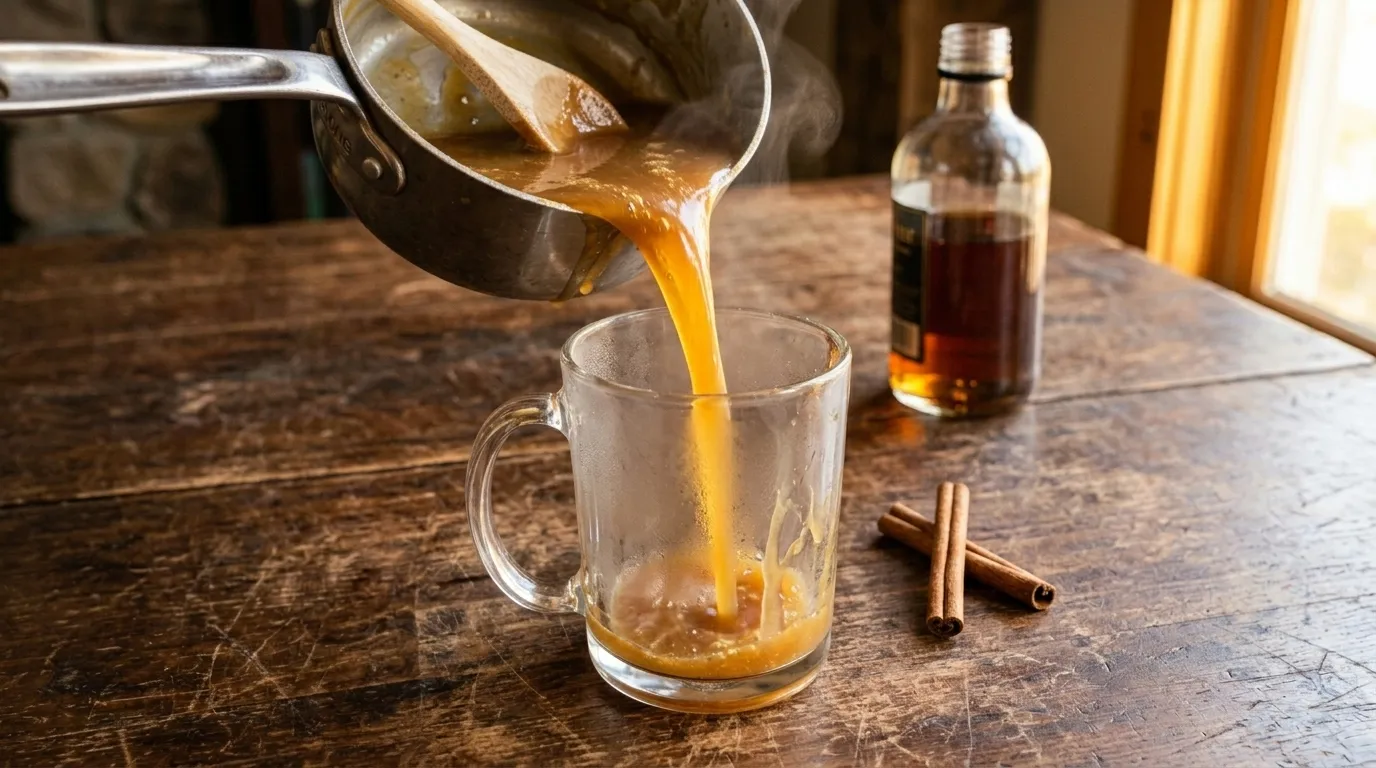
The first thing I got wrong was the butterscotch base. You’d think butterscotch is straightforward — butter, brown sugar, cream, done. And technically, yes, that produces butterscotch. But it produces flat butterscotch. Sweet, one-note, the kind of butterscotch that tastes like a candy wrapper smells. What Rosmerta’s Butterbeer had was depth. A caramel darkness. A slight bitterness at the edges. You know how brown butter smells different from melted butter? Same principle. You need to push the sugar further than feels comfortable. I cook the brown sugar in the butter until it foams and the color shifts from golden to a deep amber — about four and a half minutes on medium heat, and I mean medium, because the difference between “complex caramelization” and “burnt sugar you’re scraping into the trash at midnight” is about fifteen seconds. Ask me how I know.
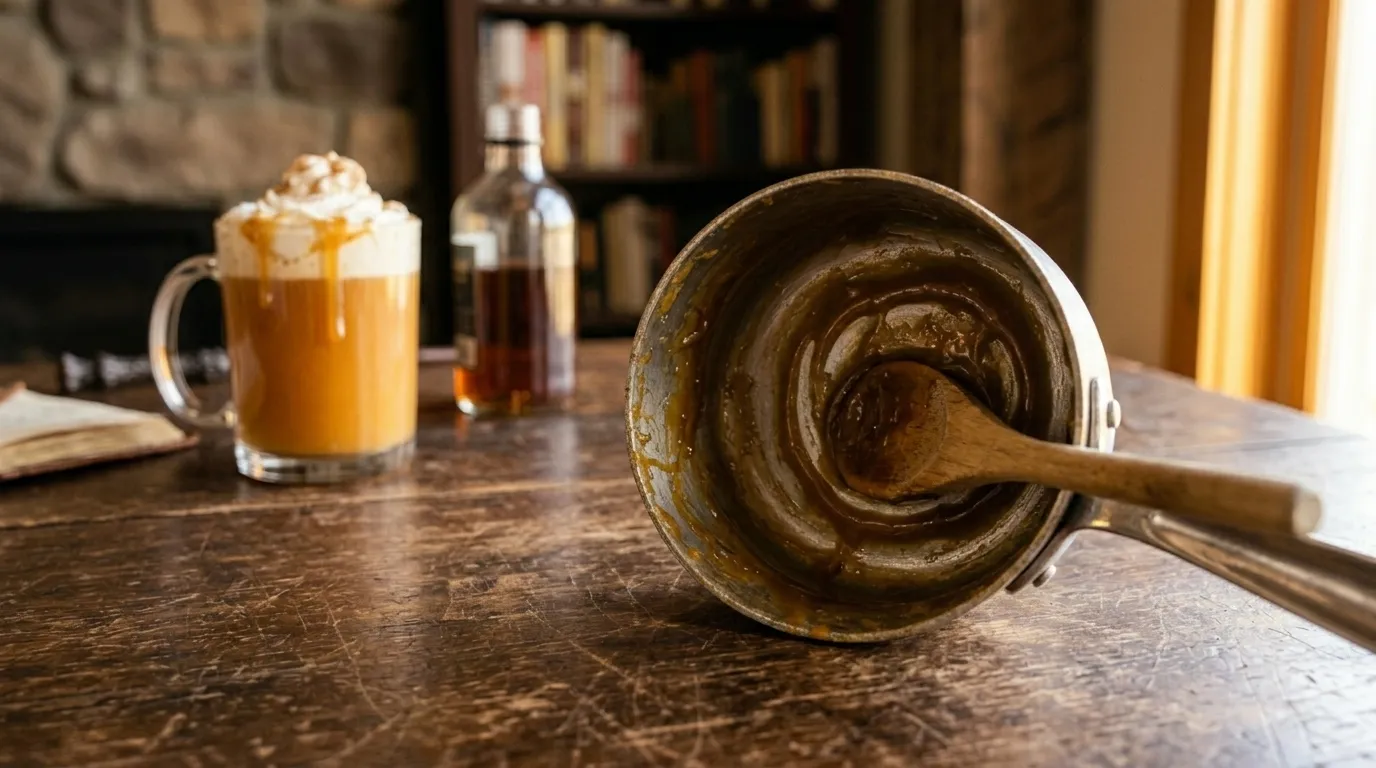
Batch three was the first one that looked right. Beautiful amber color. Gorgeous foam. I was so excited that I FaceTimed Lena and made her watch me take the first sip. It tasted like cough syrup. Not metaphorically — it had that specific medicinal sweetness that happens when the sugar-to-cream ratio is too high and there isn’t enough fat to round it out. “Your face is doing something,” Lena said. I hung up.
The breakthrough came at 2 AM on a Wednesday. I was at the stove in my bathrobe because I’d had a thought about salt — specifically, about the role of salt in butterscotch, which is not to make it salty but to interrupt the sweetness, to create contrast in the same way that a rest in music makes the next note louder. I’d been using a pinch. What Rosmerta’s version needed was a proper pinch — a generous one, maybe a quarter teaspoon for the batch size, enough that you’d never identify it as salt but you’d miss it if it was gone. I also bumped the vanilla. Real vanilla extract, not imitation — the difference is not subtle, it’s structural. Imitation vanilla is vanillin, a single compound. Real extract has vanillin plus about 250 other flavor compounds that create what pastry chefs call “roundness.” I use Nielsen-Massey. It’s expensive. It’s worth it. This is not a place to save two dollars.
The rum matters more than you think. Dark rum, specifically — and I want to be precise about what I mean by “dark,” because the liquor store uses that word to mean about twelve different things. What you want is an aged rum with molasses depth, not just caramel coloring. Gosling’s Black Seal is my preference: it has this treacle quality, almost burnt-sugar, that mirrors the caramelized butterscotch base in a way that makes the whole drink taste like it was always meant to be one thing. Appleton Estate 12 Year is the upscale option if you want a smoother, more refined version. Myers’s is fine in a pinch. Captain Morgan is not fine in any pinch. I tested all four and the difference is significant — the cheap stuff makes the drink taste boozy and college-party. The good stuff makes the alcohol disappear into the butterscotch like it was always there.
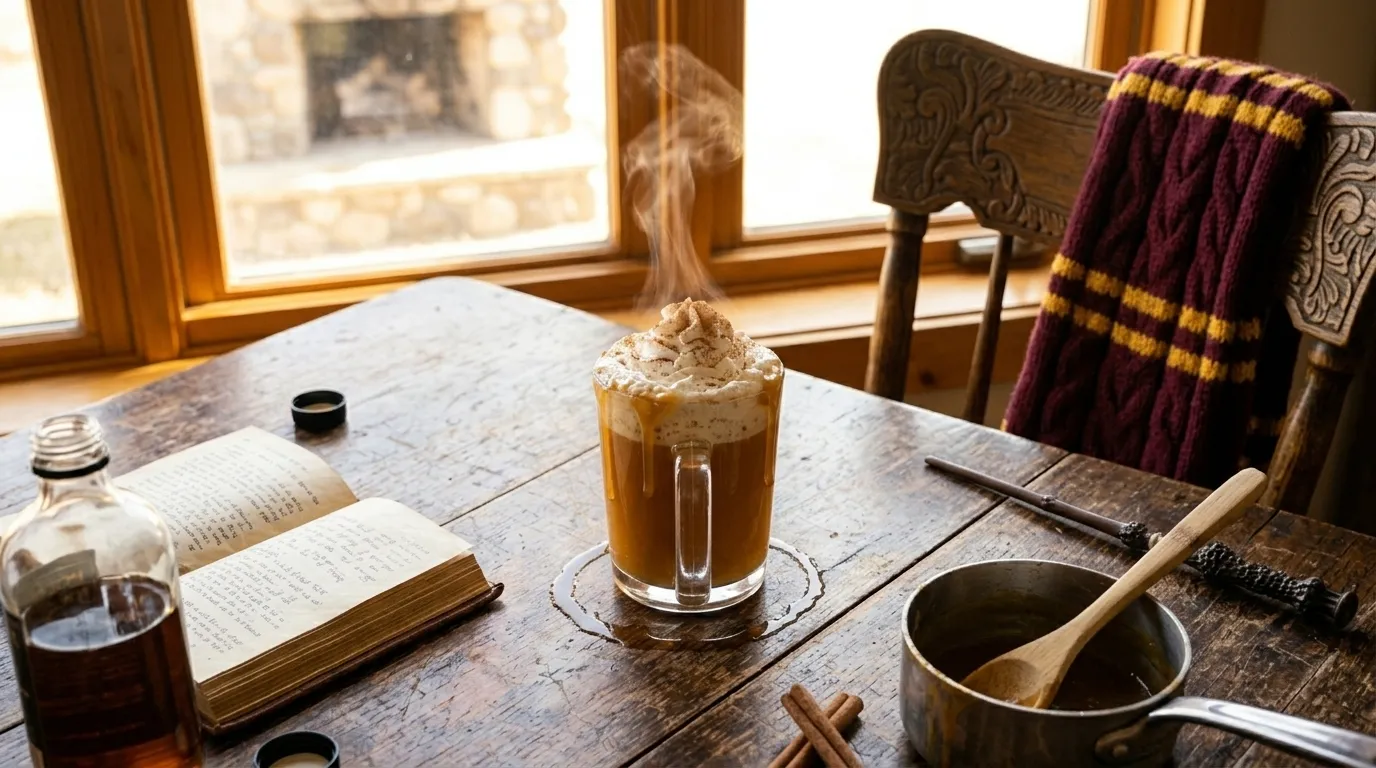
One more thing about the cream soda: it needs to be flat. Not fully flat — you want a memory of carbonation, a slight effervescence, but not the aggressive fizz of a just-opened bottle. Open it an hour before you start. Or pour it into a bowl and stir it a few times. The carbonation fights the cream top if it’s too active — the bubbles push through and break the foam, and then you have butterscotch rum with sad cream bits floating in it, which is a different drink entirely, and not a good one.
The foam — I should tell you about the foam. Rosmerta’s foam was not whipped cream as we know it. It was thicker, denser, almost like a very soft cream cheese that hadn’t quite committed. I tested heavy whipping cream at various stages: fifteen seconds past soft peaks is the sweet spot. You want it to hold its shape when spooned onto the drink but slowly, slowly melt into the surface over the next two minutes. If it sits there like a hat, you’ve gone too far. If it dissolves immediately, you haven’t gone far enough. Practice once without the drink underneath. Just whip some cream, plop it on some warm water, and watch. You’ll know when it’s right.
This is the Butterbeer I wanted when I was seven years old, reading in bed, my mother’s voice turning the page. It’s the Butterbeer I wanted at nineteen, when the theme park version tasted like liability insurance. It’s the Butterbeer I wanted at that table in the Three Broomsticks, and it’s the Butterbeer I want now, on a Tuesday, when the day has been long and the kitchen is warm and I need to feel like the world contains magic even when the news says otherwise.
Make this for a cold night. Make this for someone you love. Make this for yourself, alone, wrapped in a blanket, rereading the chapter where they go to Hogsmeade for the first time.
You guys. Please make this and tell me about it. Send me photos. Send me your butterscotch base tweaks. Send me the story of who you drank it with and what you talked about while you held the mug with both hands.
And call your mom. Or whoever read you the books. Tell them you remember.
The Hogsmeade Warmth (Butterbeer)
Ingredients
For the Butterscotch Base
For the Cocktail
Instructions
Make the Butterscotch Base (do this first)
- Melt the butter in a saucepan over medium heat. Watch it — you want it foaming and just barely starting to smell nutty.
- Add the brown sugar and stir until it dissolves into the butter and the whole thing looks like a bubbling caramel situation you're mildly concerned about. Good. Be mildly concerned.
- Pour in the cream slowly, stirring constantly. It will seize up and look like a mistake. It is not a mistake. Keep stirring.
- Add vanilla and salt. Let it simmer for 5 minutes until slightly thickened and your kitchen smells like the Three Broomsticks common room.
- Remove from heat and let cool. This makes enough for multiple drinks and you will need multiple drinks.
Make the Butterbeer
- Combine the rum, butterscotch base, and cream soda in a mug. A clear glass mug, if you have one. You deserve to see that color.
- Warm gently on the stove or in the microwave if you want authentic hot Butterbeer. Not boiling — just warmer than your hands, the temperature of being held.
- Whip the heavy cream until it forms soft peaks, then beat it for exactly five more seconds. You want it just past soft peaks. This is not negotiable.
- Float the whipped cream on top using a spoon.
- Drizzle with butterscotch sauce and dust with cinnamon.
- Hold the mug with both hands. This is mandatory. It doesn't taste right if you hold it with one hand. I don't make the rules.
Magnolia’s Notes
-
On the butterscotch base: Make a big batch and keep it in the fridge — it’ll last about two weeks and works in coffee, on ice cream, in oatmeal, or consumed directly from the container at 2 AM while standing in front of the open refrigerator in your bathrobe. The base is also the variable that controls everything. Too sweet? Add more salt next time. Too flat? Push the caramelization longer. Too thin? Simmer it another two minutes. Keep a notebook. I have six pages of butterscotch notes and I am not embarrassed.
-
On the rum: Gosling’s Black Seal is my hill and I will expire upon it. The molasses backbone mirrors the brown sugar in the butterscotch base and the whole drink sings in one key instead of two. Appleton Estate 12 Year if you want to feel fancy. Do not use spiced rum — the added spices compete with the cinnamon and vanilla and the result tastes confused, like a drink having an identity crisis. I tested this. The drink had a crisis.
-
On the foam: The difference between good Butterbeer foam and bad Butterbeer foam is about five seconds of whipping. Soft peaks are too soft — the cream dissolves on contact and you get a sad, thin layer that vanishes before you can photograph it (relevant). Stiff peaks are too stiff — it sits on top like a decorative hat and doesn’t integrate with the drink. You want the fifteen-seconds-past-soft-peaks zone, where it holds its shape but slowly, dreamily melts into the surface. Spoon it on. Don’t pipe it. This isn’t a Starbucks.
-
On the cream soda: Open the bottle an hour before you start and let it go slightly flat. Full carbonation fights the cream top and makes the drink fizzy in a way that isn’t wrong exactly but isn’t right either. You want a whisper of effervescence, not a shout. If you forgot to open it early, pour it into a bowl and stir it around for thirty seconds. Science.
-
On temperature: Serve it warm, not hot. If the mug is too hot to hold with both hands, it’s too hot. You should be able to wrap your fingers around it and sigh. That’s the target temperature: sigh-degrees.